
Artificial Intelligence NVIDIA
NVIDIA buys Hugging Face for 12.93 billion: the definitive commitment to the open AI ecosystem
2026-09-06 · 11 min read
By Álvaro AbrilCEO de Geniales.co · Director de KingNews.online
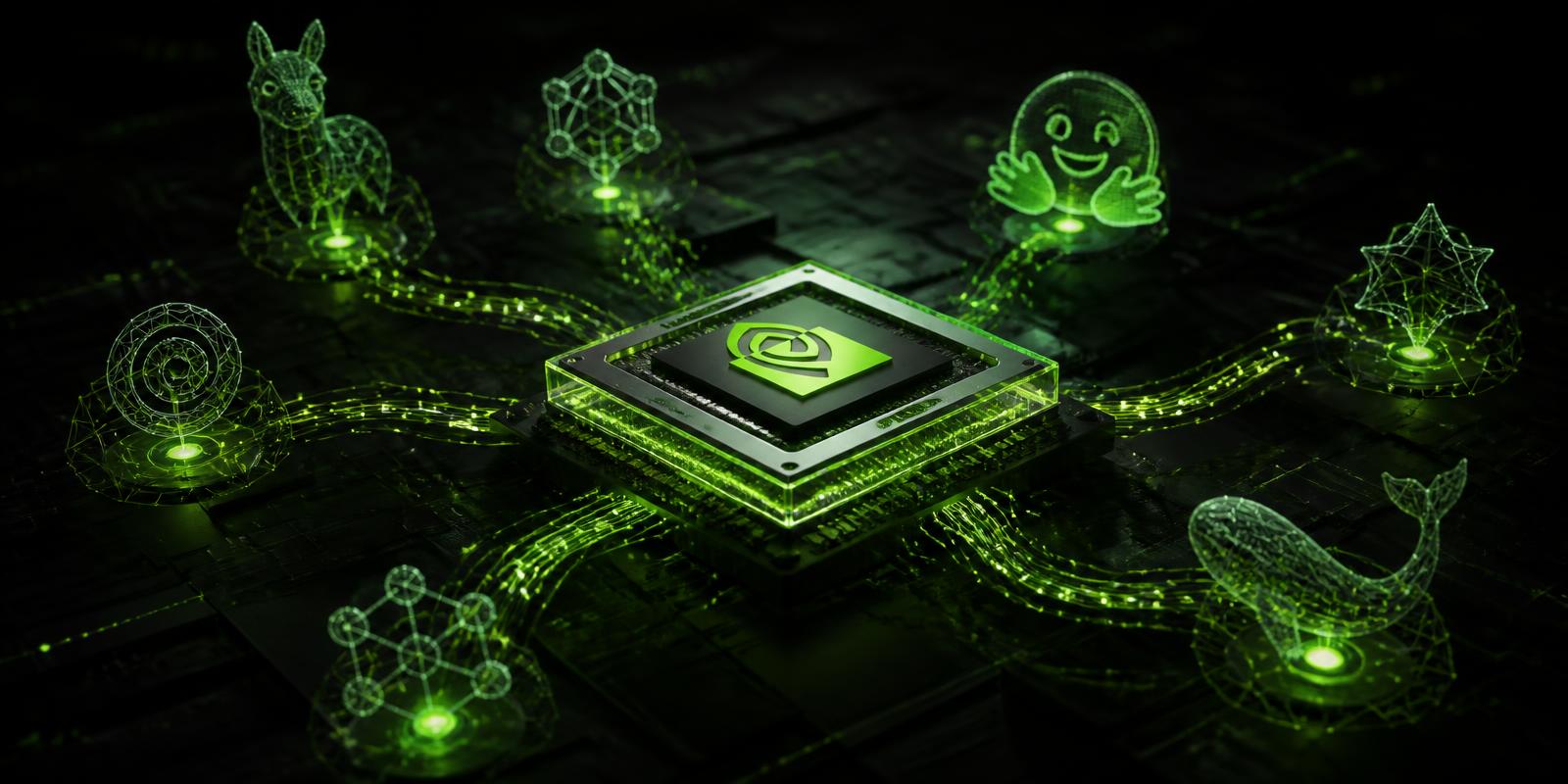
The largest acquisition in NVIDIA's history adds three million models, half a million datasets and 18 million developers to the chipmaker's ecosystem. Jensen Huang promises that the platform will remain open and hardware-neutral.
$12,930,300,000 for the Heart of Open Source
On September 3, 2026, Jensen Huang personally signed the announcement on NVIDIA's corporate blog: the company agreed to acquire Hugging Face for $12,930,300,000. The figure, written out to the very last digit, is the largest single transaction in the manufacturer's thirty-three-year history and comes after weeks of rumors in Silicon Valley.
Of that total, nearly 11.9 billion goes to Hugging Face investors, and up to an additional 1 billion is set aside as an equity retention program for employees who join NVIDIA. It is a structure designed to retain talent, not just assets: on a community platform, the people who maintain it are worth just as much as the code.
What NVIDIA is taking home is not a closed product, but an ecosystem: three million hosted models, half a million datasets, one million applications, and a community of more than 18 million developers that is today, indisputably, the gathering place of global machine learning.
| Concepto | Cifra |
|---|---|
| Valor total de la operación | US$12.930.300.000 |
| Pago a inversionistas | ≈ US$11.900 millones |
| Programa de retención de empleados | Hasta US$1.000 millones |
| Modelos alojados en la plataforma | ≈ 3.000.000 |
| Datasets públicos | ≈ 500.000 |
| Aplicaciones (Spaces) | ≈ 1.000.000 |
| Desarrolladores activos | > 18.000.000 |
| Fecha del anuncio | 3 de septiembre de 2026 |
The Key Promise: It Will Remain Open and Neutral
The most sensitive aspect of the deal is not the price, but governance. Huang was explicit: Hugging Face will remain an open platform and will not require the use of NVIDIA chips. Models can be trained and run on any accelerator from any manufacturer, just as before.
That commitment is more rational than it seems. NVIDIA's business does not depend on closing doors, but rather on the existence of an ever-growing number of models that someone needs to train and serve. Every new model published on the platform—wherever it comes from—increases the global demand for compute, and NVIDIA remains the natural provider of that compute.
In less than a decade, founders Clément Delangue, Julien Chaumond, and Thomas Wolf built something no corporation had managed to buy before: community trust. Breaking that trust would destroy precisely the acquired asset. Neutrality is not generosity; it is the only strategy that preserves the value of the 12,930 million.
From Video Game Graphics Cards to the Center of the Global Economy
To understand the magnitude of this purchase, one must go back to 1993, when Jensen Huang, Chris Malachowsky, and Curtis Priem founded NVIDIA at a Denny's in San Jose, California. The initial bet was simple: personal computers were going to need dedicated graphics processors. The first product, the NV1 in 1995, was virtually a commercial failure.
The company survived with the RIVA 128 in 1997 and exploded in 1999 with the GeForce 256, which NVIDIA dubbed the world's first GPU. That same year, it went public. Over the following decade, it was, above all, the gamers' company: performance, frames per second, and benchmark wars against ATI.
The decisive turning point came in 2006 with CUDA, the platform that enabled GPUs to be programmed for general-purpose computing. It was an expensive decision, unpopular among analysts, and without an obvious market for years. Huang stood by it anyway. In 2012, when AlexNet won the ImageNet competition trained on GeForce GPUs, it became clear that deep learning needed precisely the hardware that NVIDIA had spent six years preparing.
From then on, the story is well known: Tesla, Volta, Ampere, Hopper, and Blackwell; data centers overtaking video games as the primary source of revenue; and, in 2024, joining the club of the world's most valuable companies, with a market capitalization exceeding four trillion dollars. The company that once sold gaming cards ended up becoming the infrastructure upon which artificial intelligence is built.
Jensen Huang: The Leather Jacket and Thirty Years of Patience
Jen-Hsun "Jensen" Huang was born in Tainan, Taiwan, in 1963. His family emigrated to Thailand and later sent him, along with his brother, to the United States as a child. He ended up at a rural boarding school in Kentucky where, as he has recounted himself, he cleaned bathrooms and shared a dormitory with students considerably tougher than he was. He learned English and table tennis at the same time, going on to compete at the national junior level.
He studied electrical engineering at Oregon State—where he met his wife, Lori—and earned a master's degree from Stanford. He worked as a microprocessor designer at AMD and LSI Logic before founding NVIDIA at age thirty. He has been at the helm of the same company ever since: one of the longest and most successful founder-CEO tenures in the tech industry.
His management style is a deliberate anomaly. He does not use traditional hierarchical email, maintains dozens of direct reports, avoids formal performance reviews, and repeats that the company always lives "thirty days from going out of business" as a way to maintain urgency. His favorite phrase in interviews sums up his career better than any analysis: greatness does not come from intelligence, it comes from character, and character is formed through suffering.
The black leather jacket became his visual signature, but the real story lies elsewhere: Huang bet on CUDA a decade before the market that makes it essential today even existed. This purchase of Hugging Face follows the same long-term logic.
Why Buy a Community and Not a Technology
In the software industry, the hardest asset to replicate is not the algorithm: it is habit. Hugging Face became the place where a researcher publishes their model, where a startup downloads it, and where a university evaluates it. That habit cannot be bought with a marketing budget.
For NVIDIA, the acquisition closes a strategic circle. It already controls the hardware (Blackwell GPUs and successors), the programming layer (CUDA), the inference libraries (TensorRT, NIM), and now the distribution of open models. It is vertical integration across the entire AI value chain, without the need to enforce exclusivity at any point.
It is also a sensible defensive move. The major closed-model labs are designing their own accelerators; cloud providers are doing so as well. Strengthening the open ecosystem—where thousands of teams train their own models on heterogeneous hardware—diversifies compute demand and reduces NVIDIA's dependence on a handful of giant clients.
What Changes for Developers and Companies
In the short term, little: the platform continues to work the same, repositories remain accessible, and open licenses are not modified. In the medium term, what is expected is considerably more robust infrastructure—storage, bandwidth, download speeds—funded by a balance sheet of another dimension.
For companies building products with AI, the news is good for a very specific reason: it reinforces the viability of open models as a real alternative to closed APIs. An open model running on your own infrastructure means cost control, data control, and no dependency on a single vendor.
At Geniales.co, we work on precisely that point: we integrate open and commercial models into custom-built platforms with React 19, TypeScript, TanStack, and PostgreSQL, choosing in each case the model that best balances cost, latency, and privacy. Having the world's largest chipmaker back the open ecosystem validates this architecture for any company that wants AI without being tied to a single vendor.
What Remains to Be Seen
Two serious unknowns remain. The first is regulatory: a transaction of nearly 13 billion uniting the dominant provider of accelerators with the dominant repository of open models will be closely scrutinized in the United States and the European Union. The promise of hardware neutrality is probably the central argument NVIDIA will present to regulators.
The second is cultural. Hugging Face is a community with a very distinct identity, skeptical of corporate power and fiercely protective of its independence. The retention program of up to 1 billion suggests that those in Santa Clara are perfectly aware of the risk: if the original team disperses, what was purchased quickly loses value.
If the transaction is executed well, the result would be an open ecosystem that is better funded and more stable than ever. If executed poorly, the community will simply migrate to another platform, because open source has no switching costs. NVIDIA knows this, and that awareness is the best guarantee that it will deliver on its promises.
Enlaces
Get KingNews in your inbox
Tech and gaming digest, no noise. Unsubscribe anytime.
Want to send us a news story?
Tell us your story. Our editorial team reviews it and gets back to you.
Would you like to advertise with us?
Write to us and we'll send you ad options and audience data.
More stories
Comercio electrónico · Eventos · Colombia
Feria Effix 2026: Medellín se convierte en la capital del comercio electrónico
Robótica · Inteligencia artificial · Sistemas autónomos
La colmena blindada: robots terrestres que podrían comandar enjambres de drones
Agrotecnología · Inteligencia artificial · Ganadería
La granja autónoma toma forma: IA, drones y robots llegan al campo

Inteligencia artificial · Empresas · Opinión
BMW adelgaza su dirección con IA: ¿ha llegado la hora del gerente artificial supervisado?
Inteligencia física · Agricultura · Robótica industrial
Polybot enseña a un robot a cosechar tomates mirando cómo trabajan los humanos
Inteligencia física · Robótica · Aprendizaje autónomo