
Vitestro · Medical robotics
FDA authorizes Aletta: the first robot that draws your blood without anyone holding its hand
2026-09-02 · 6 min read
By Álvaro AbrilCEO de Geniales.co · Director de KingNews.online
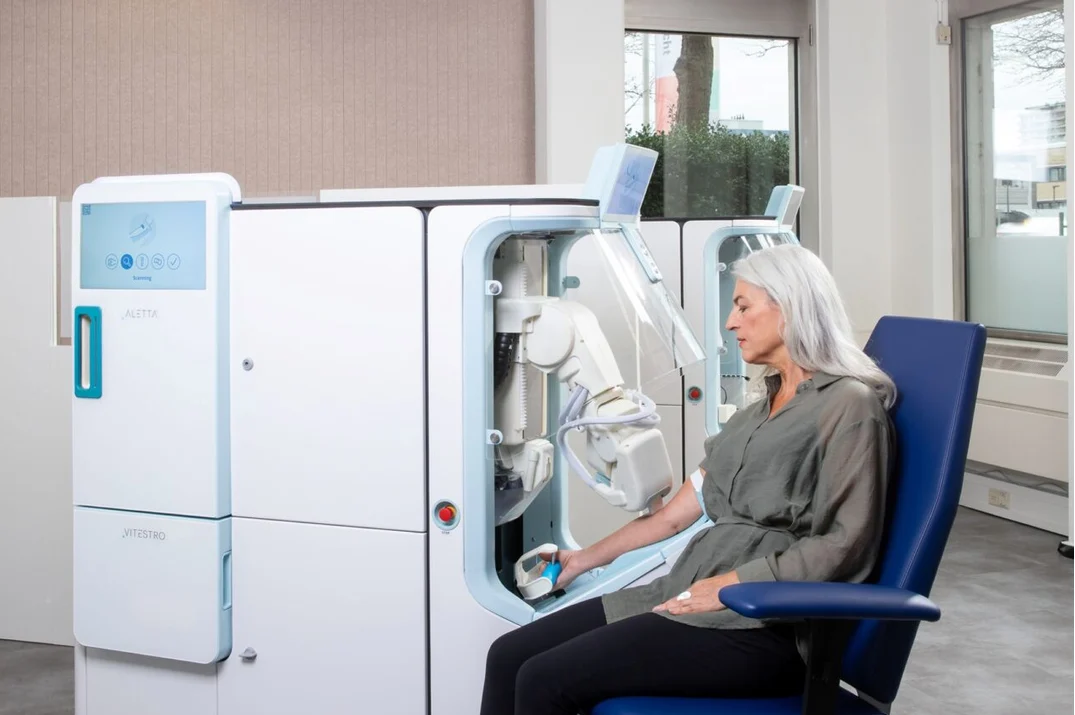
The U.S. agency granted De Novo authorization for the device from Dutch company Vitestro, the first autonomous robotic blood collection system. De Novo is the pathway used when a product is so novel that a regulatory category does not even exist to place it in.
An Authorization That Creates Its Own Category
The FDA authorized Aletta, the device from Dutch company Vitestro: the first autonomous robotic system capable of drawing blood without manual operator intervention. It did not arrive through the usual route of equivalence with an existing product, but through De Novo, the pathway reserved for devices so new that they do not fit into any prior classification. When the FDA uses De Novo, it is admitting something important: there was no box, one had to be created.
That makes Aletta the regulatory predicate for everything that comes next. Anyone wishing to launch a phlebotomy robot in the United States will no longer have to blaze a trail: they will have to compare themselves to Vitestro.
How It Works
The system combines multimodal imaging—near-infrared, ultrasound, and Doppler—to locate the vein and, critically, distinguish it from an artery. Based on that reconstruction, AI-guided robotics calculates the angle, depth, and trajectory of the needle in real time, making corrections if the vessel shifts.
And it executes the entire procedure: tourniquet placement, skin preparation, puncture, tube switching, needle withdrawal, and dressing application. The healthcare professional presses a button and supervises. They do not hold the arm, do not search for the vein, and do not repeat the stick.
The Doppler is the elegant piece of the equation: it is what allows an arterial puncture to be ruled out, precisely the error that is most feared when automating.
On video, the full sequence is better understood: the patient rests their arm, the system scans, decides, and executes.
The data supporting the authorization
The clinical evidence presented shows a success rate comparable to or higher than that of trained human phlebotomists, consistent results in patients with difficult venous access and across different skin tones, and rare, mild adverse events.
The point regarding skin tones is not a footnote: a large portion of optical medical devices have historically failed due to being trained on insufficiently diverse populations. That Aletta addresses this head-on is what lends credibility to the rest of the figures.
| Etapa | Flebotomía manual | Aletta |
|---|---|---|
| Localización de la vena | Palpación y experiencia del operador | Infrarrojo + ultrasonido + Doppler |
| Punción | Pulso humano, variable por fatiga | Robótica guiada por IA |
| Cambio de tubos | Manual | Automático |
| Rol del humano | Ejecuta todo el proceso | Pulsa un botón y supervisa |
| Variabilidad | Alta entre operadores | Consistente por diseño |
Automation always starts with the same thing
The underlying reading is more interesting than the device itself. Automation does not conquer the most complex jobs first, but rather the most repeatable, the most measurable, and those facing labor shortages. Phlebotomy had met all three requirements for decades: hundreds of millions of blood draws per year, a standardized protocol, objective success metrics, and a chronic shortage of staff in laboratories and hospitals.
The FDA has not invented anything: it has simply signed off on the obvious. And that pattern repeats across every sector. The same thing happened in gaming: the first thing to be automated was not a venue's commercial strategy, but chip counting, bill validation, and the calculation of progressive jackpots—repetitive, measurable, and critical tasks. When a process can be described with rules and audited with numbers, sooner or later it is executed by a machine.
What does not disappear is judgment. Aletta does not decide which lab tests to order, nor does it interpret the results: it flawlessly executes a bounded task. As always, human labor is not eliminated; it shifts upward.
Enlaces
Get KingNews in your inbox
Tech and gaming digest, no noise. Unsubscribe anytime.
Want to send us a news story?
Tell us your story. Our editorial team reviews it and gets back to you.
Would you like to advertise with us?
Write to us and we'll send you ad options and audience data.
More stories
Comercio electrónico · Eventos · Colombia
Feria Effix 2026: Medellín se convierte en la capital del comercio electrónico
Robótica · Inteligencia artificial · Sistemas autónomos
La colmena blindada: robots terrestres que podrían comandar enjambres de drones
Agrotecnología · Inteligencia artificial · Ganadería
La granja autónoma toma forma: IA, drones y robots llegan al campo

Inteligencia artificial · Empresas · Opinión
BMW adelgaza su dirección con IA: ¿ha llegado la hora del gerente artificial supervisado?
Inteligencia física · Agricultura · Robótica industrial
Polybot enseña a un robot a cosechar tomates mirando cómo trabajan los humanos
Inteligencia física · Robótica · Aprendizaje autónomo