
Artificial intelligence · Companies · Opinion
BMW thins its management with AI: has the time come for the supervised artificial manager?
2026-10-01 · 10 min read
By Álvaro AbrilCEO de Geniales.co · Director de KingNews.online

BMW will reduce its divisions and associated management positions by 20% as it spreads AI agents throughout the company. He didn't announce that an algorithm would take over the boss's chair, but the move opens up a bigger question: what would an organization gain from having a supervised AI at the helm of an area.
What BMW Really Announced
On September 30, 2026, during its Capital Market Day, BMW Group presented a program to regain profitability and agility. Its official statement mentions a 20% reduction in the number of divisions and associated management positions by mid-2027, with a comparable reduction across lower organizational levels. It also plans to simplify processes and expand the use of artificial intelligence in development, purchasing, production, sales, marketing, and aftersales.
The company expects digital agents to analyze complex information, automate routine tasks, and accelerate decision-making. In engineering, BMW was explicit: AI outputs will be monitored, reviewed, and ultimately approved by developers. That phrase defines the responsible model better than an easy headline: broad automation, yes; identifiable human authority, too.
BMW links these measures to a financial goal: bringing the automotive business's EBIT margin to between 3% and 5% in 2028 and returning to the historical range of 8% to 10% by the beginning of the next decade. It does not attribute this entire outcome to AI; it will also cut variants, regionalize products, and reorganize its structure.
Álvaro Abril's idea: a supervised AI as an area manager
My proposal is not to hand over a company to a black box. It is to create a supervised AI management role, with objectives defined by the organization, controlled access to its systems, and an individual responsible for authorizing sensitive decisions. The AI would manage the operational flow, while the human would retain legal, ethical, and strategic authority.
Such management would not have to wait for Friday's committee meeting to discover a deviation that the ERP recorded on Monday. It could continuously monitor sales, inventory, purchasing, accounts receivable, productivity, and quality; compare what happened against budgets and policies; explain the anomaly; and propose an action before the problem turns into a monthly closing issue.
From Geniales.co and KingNews.online, we see BMW's announcement as a signal, not finished proof: artificial intelligence is ceasing to be an isolated tool and becoming a layer of business coordination. The serious leap does not consist of AI drafting reports, but in connecting data, processes, and decisions under auditable rules.
Eight potential advantages—if the system is well-governed
Operational honesty. An AI does not need to doctor metrics to protect its career or conceal a mistake to preserve influence. It can log what data it read, what rule it applied, and why it recommended an action. But that honesty depends on data integrity and on ensuring no one configures the system to reward a convenient conclusion.
Data-driven decisions. It can consolidate signals from ERP, CRM, production, support, and treasury into a single reading; model scenarios and update priorities with up-to-date data. It does not replace judgment when a problem is ambiguous, but it reduces decisions made solely on intuition or driven by the most persuasive presentation.
Fairness and absence of personal favoritism. A machine has no friendships, grudges, or protégés. It can apply the same documented criteria to equivalent cases. However, it can also inherit historical biases from evaluations, compensation, or hiring; this is why fairness must be measured through periodic audits, the right to an explanation, and human review.
Speed. It can process thousands of transactions, detect exceptions, and prepare options in minutes. The advantage is not rushing every decision, but rather reserving human time for irreversible decisions while repetitive workflows advance within pre-approved thresholds.
Connection with ERP and other applications. Integrated via least-privilege permissions, AI can transform scattered information into coordinated alerts and actions. Every access and every modification must be logged; no artificial manager should have a master password or unchecked authority to execute payments, dismiss, hire, or alter records.
Continuous improvement. Decisions can be compared against real-world outcomes to fine-tune forecasts and identify obsolete rules. Learning must not mean modifying itself without oversight: new versions, data sources, and policies require testing, approval, and rollback capabilities.
Preservation of know-how. Procedures, exceptions, historical context, and expert solutions can be turned into searchable institutional memory. When someone retires or moves to another company, that knowledge does not vanish inside their inbox. The company, in turn, must respect authorship, confidentiality, and access rights over that expertise.
Continuity and consistency. The system can operate through shift changes, vacations, or peak workloads without losing context. This does not eliminate leaders; it prevents an entire department from relying on the memory or availability of a single individual.
| Capacidad | Beneficio | Control indispensable |
|---|---|---|
| Lectura de datos | Decisiones con cifras actuales | Calidad, procedencia y permisos |
| Aplicación de reglas | Consistencia y menor favoritismo | Auditoría de sesgos y apelación |
| Automatización | Mayor velocidad operativa | Límites por riesgo y reversión |
| Integración | ERP, CRM y operación coordinados | Acceso mínimo y bitácora completa |
| Aprendizaje | Mejora basada en resultados | Versionado, pruebas y aprobación |
| Memoria | Know-how disponible a largo plazo | Gobierno, privacidad y propiedad |
AI Is Neither Honest nor Impartial by Nature
It is worth dispelling an illusion: a model possesses neither ethics, loyalty, nor a sense of justice. It produces results based on data, instructions, tools, and objectives. If the metric rewards cutting costs without protecting quality, safety, or decent employment, it will optimize the wrong figure with formidable discipline.
Nor is it enough to say that it has no favorites. If it learns from a company that for years promoted one group more than another, it can turn that inequality into a statistical pattern. And if its explanations are impossible to audit, apparent neutrality can conceal decisions that are harder to challenge than those of a human boss.
That is why the decisive word is supervised. A person or committee must be accountable for the objective, permitted data, autonomy thresholds, and consequences. The company needs to separate recommendations, reversible actions, and high-impact decisions; the latter must retain effective human review.
What hybrid management would look like in practice
In a commercial department, for example, AI could review sales, margins, inventory, accounts receivable, complaints, and delivery capacity every morning. It would detect that a promotion increases revenue but erodes margins, or that a region is selling well while accumulating returns. It would then propose reallocating budget, adjusting the forecast, or escalating an exception.
Low-risk actions—creating an alert, requesting information, scheduling a report—could execute autonomously. Medium-risk actions would require approval from a manager. High-impact actions—contracts, disciplinary measures, salary changes, credit approvals, or fund transfers—would remain under human decision-making and segregated controls.
AI performance would be evaluated just like that of any manager: forecast accuracy, value generated, errors, compliance, fairness, team satisfaction, and the ability to explain decisions. If only speed or cost savings are measured, the system will learn to sacrifice whatever the company forgot to put on the dashboard.
The lesson from BMW is not to replace people one by one
BMW is combining a flatter structure with AI integrated into processes and data accumulated over decades. The announcement does not state that it will appoint an AI manager or that every eliminated position will be filled by an agent. It says something more concrete: there will be fewer management layers and tools capable of accelerating analysis, automation, and decision-making.
That design can increase productivity, but it also concentrates responsibility. A manager using AI could make better decisions across a larger area; they could also propagate an error at greater speed. The answer is not to hold back the technology, but to design controls proportional to its scope.
My conclusion is favorable, with one non-negotiable condition: yes to AI managing day-to-day operations; no to AI owning the responsibility. When there is traceability, reliable data, boundaries, oversight, and the ability to appeal, the organization gains speed without relinquishing judgment. That is where the true future of hybrid management lies.
Enlaces
- BMW Group — anuncio oficial del Capital Market Day 2026
- Bloomberg — BMW Targets Shedding 20% of Managers Through AI
- RT — nota que originó este análisis
- OCDE — Algorithmic Management in the Workplace
- Business Research — discriminación en decisiones algorítmicas de recursos humanos
- Geniales.co
- KingNews.online
Get KingNews in your inbox
Tech and gaming digest, no noise. Unsubscribe anytime.
Want to send us a news story?
Tell us your story. Our editorial team reviews it and gets back to you.
Would you like to advertise with us?
Write to us and we'll send you ad options and audience data.
More stories
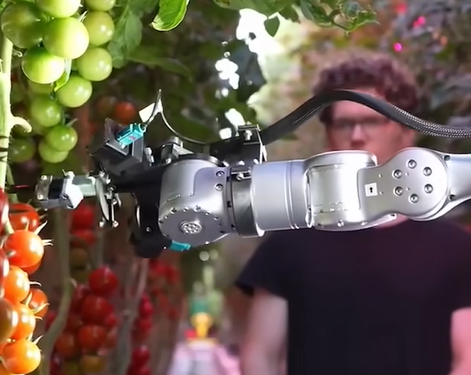
Inteligencia física · Agricultura · Robótica industrial
Polybot enseña a un robot a cosechar tomates mirando cómo trabajan los humanos
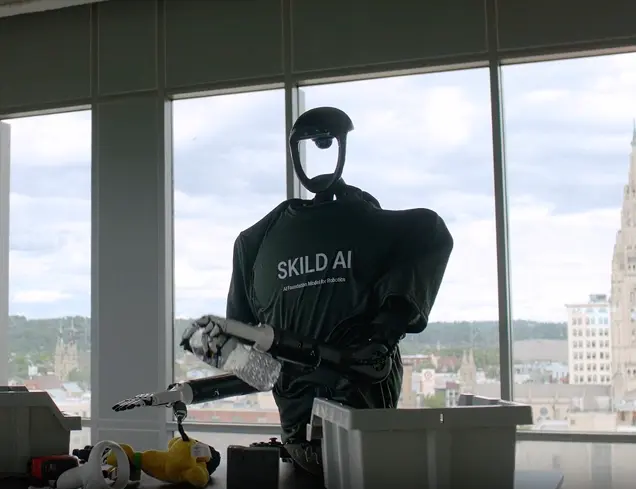
Inteligencia física · Robótica · Aprendizaje autónomo
El robot de Skild AI que aprendió a jugar fútbol contra sí mismo durante 140 años simulados

Movilidad eléctrica · Arabia Saudita
Ceer EXOBOT: Arabia Saudita presenta su primer auto eléctrico y quiere construir una potencia automotriz
Inteligencia Artificial · Lenguas · India
¿Puede la IA preservar las lenguas de India? El mapa cultural de sus 121 idiomas

Materiales · Industria textil
Del bambú a una camiseta suave: la transformación que no siempre nos cuentan
Aviación · Robótica