
Science Fiction · Consciousness · Possible Futures
What If You Were Already Living Another Life?
2026-10-28 · 11 min read
By Álvaro AbrilCEO de Geniales.co y director de KingNews.online
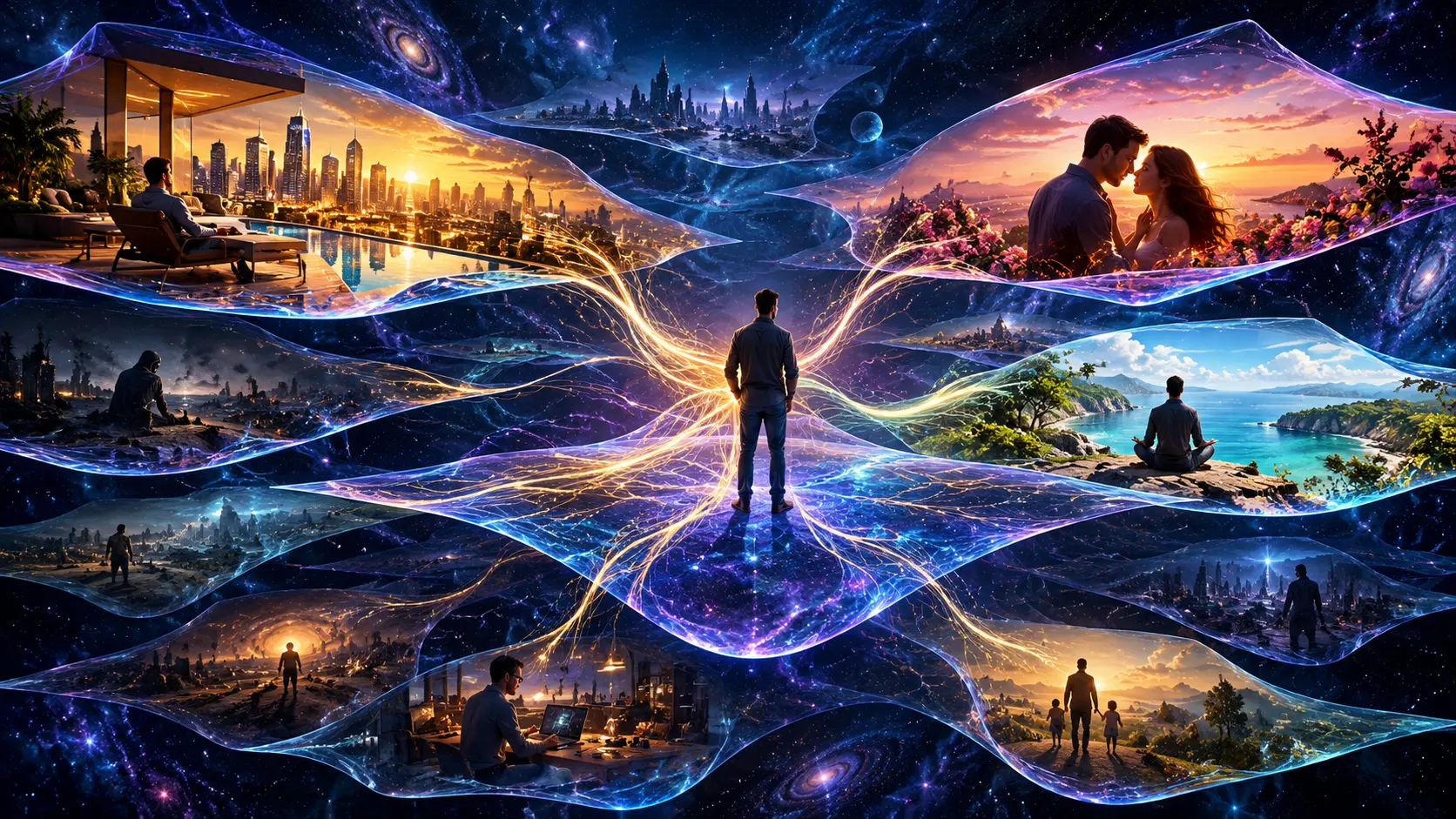
The invisible thread that could connect our realities, parallel universes, and the mystery of consciousness. A work of speculative fiction by Álvaro Abril that explores possible lives, identity, and the decisions that open new paths.
Speculative fiction: the invisible thread between our realities
A work of speculative fiction inspired by concepts of theoretical physics. The mechanisms described in this story are imaginary and do not represent scientifically proven phenomena.
Imagine that, somewhere in a reality you cannot see, another version of you exists.
In that life, you made a different decision. Perhaps you accepted that job offer, met someone else, started a business that ended up becoming a success, or simply learned to live without the weight of certain worries.
In another version, you have more money. In another, you found love. In yet another, you discovered that happiness did not depend on any of those things.
Now imagine something even more unsettling: what if all those possibilities were layers of a single reality, and your consciousness could only experience one of them at a time?
We are not claiming that this happens. We are entering the realm of science fiction, where the questions of theoretical physics meet the great enigmas of human existence.
The question that guides this story is as simple as it is unsettling:
What if changing your life did not mean changing who you are, but changing the reality you experience?
1. The universe could be stranger than we perceive
Modern physics has shown that reality does not always behave as our everyday intuition suggests. In the quantum world, particles exhibit behaviors that challenge our conventional ideas about position, causality, and observation.
String theory attempts to describe the fundamental components of nature through tiny entities that behave like vibrating strings. Some of its formulations consider extra dimensions and extended objects known as branes.
These ideas are part of theoretical research; they do not constitute proof that accessible universes exist where we could live other lives.
On the other hand, the many-worlds interpretation of quantum mechanics proposes a way to mathematically understand the evolution of quantum states. However, it also does not prove that we can choose an alternative reality through our thoughts.
This is where our fiction begins.
Suppose that the different possible configurations of reality could be described, metaphorically, as overlapping layers. Each layer would contain a complete story, with its events, decisions, and consequences.
In one of them, you are who you are today. In another, certain circumstances of your past were different. In another, the opportunities you did not seize ended up leading you to an unexpected future.
They would not necessarily be perfect copies or better versions of you. They would be distinct trajectories of a possible existence.
But a fundamental question arises: if those layers existed, what would cause us to experience one and not another?
2. The thread that holds a life together
To explore this possibility, let us imagine a completely fictional concept: the Thread of Conscious Continuity.
It would not be a physical thread, nor a known force, nor an energy that can be measured with instruments. It would be a narrative device to represent the relationship between our identity and the sequence of experiences that we recognize as our life.
Every morning we wake up with the feeling of still being the same person who went to bed the night before. We retain memories, recognize our body, and connect the present with our past.
That continuity constitutes a fundamental part of our subjective experience.
Now let us imagine that, within this fictional universe, the thread were not immutably tied to a single trajectory of events. Suppose there could exist a form of continuity between different versions of the same personal story.
In that scenario, we would not necessarily travel as a body passing through a doorway between universes. What would change would be the trajectory of reality that our experience recognizes as the present.
The idea is compelling, but it requires an important distinction: there is no scientific evidence that consciousness can shift between branes, select universes, or transfer to alternative versions of a person.
The thread belongs to our story. The philosophical question it represents, on the other hand, is real: what makes us continue to feel like ourselves despite changing so much throughout life?
3. Thousands of Possible Lives, a Limited Consciousness
Let us now imagine that countless layers of reality exist.
In one, you run an international company. In another, you decided to dedicate yourself to scientific research. In a third, you lead a quiet life in the countryside. In another, you never left that city where your story began.
Not all versions would necessarily be happy. Some could contain greater hardships than those of your current life.
The interesting aspect of this literary hypothesis is not assuming that a perfect version of each person exists, but asking ourselves what would happen if many incompatible trajectories could be part of a broader reality.
Why wouldn't we remember those other lives?
In our fiction, the answer would be autobiographical coherence: each version of a person would have their own memories, their history, and their perception of continuity. If those stories did not share a common memory, none would have direct access to the experiences of the others.
Thus, a person would not wake up every morning remembering thousands of biographies. They would experience a single sequence of events and recognize it as their life.
This explanation is an imaginary rule of our narrative, not a scientific theory on how memory or consciousness works.
Yet it allows us to pose a fascinating question: if we cannot experience all the possibilities of our existence, how would we distinguish a life that changes because we make decisions from a life that, in this fiction, changes because our consciousness shifts to another trajectory?
4. How Would One Switch Layers?
If the narrative merely stated that we can choose another reality, it would lack internal coherence. We need to establish rules that prevent the shift from becoming a mere magical wish.
Let us propose a fictional mechanism called continuity resonance.
This is not a physical resonance identified by science. It is the name our story gives to a possible transition process between trajectories.
This process would have four stages.
First: recognize the current trajectory.
The character must understand the conditions of their life: their decisions, their habits, their relationships, their capabilities, and the circumstances that limit their options.
Second: identify a coherent alternative trajectory.
It is not enough to wish to be wealthy, loved, or happy. The new trajectory must have a plausible backstory within the rules of the narrative. What decisions, events, and circumstances could have led to that outcome?
Third: build a bridge.
The character must act. They learn, modify habits, seek opportunities, repair relationships, and make decisions that, within their known reality, bring them closer to a different life.
This stage is essential: resonance cannot function as an excuse to ignore the consequences of one's actions.
Fourth: experience the transition.
In the fictional universe, something extraordinary could happen: the character would begin to experience a different trajectory without retaining a complete memory of the transition.
However, neither he nor the reader would initially have conclusive proof of what happened. Perhaps he switched layers. Perhaps his life was transformed through a perfectly explainable chain of decisions.
The ambiguity is deliberate. It keeps the question alive without turning fiction into a pseudoscientific claim.
5. Daniel and the Three Lives He Could Have Lived
Daniel runs a small business that is going through difficult times. His income is irregular, his romantic relationship has deteriorated, and for months he has felt like he is working hard without making any progress.
One night, he wonders if his life could be different.
In the first imaginary path, Daniel discovers a business opportunity, improves his strategy, secures partners, and builds a profitable company. Over time, he achieves financial stability that previously seemed impossible.
In the second, he abandons the obsessive pursuit of growth, changes careers, and discovers that he enjoys a simpler life much more. He does not become a millionaire, but he reclaims his time, emotional well-being, and peace of mind.
In the third, he realizes that his primary struggle is not financial. He learns to communicate, rebuilds an important relationship, and finds a different way to share his life with others.
Which of those Daniels is the real one?
Within our fiction, all three could be complete versions of the same identity across different paths. None would necessarily be superior to the others.
And if the Thread of Conscious Continuity allowed for a transition, which one would Daniel choose?
The answer would depend on the rules we establish for the narrative. Perhaps his consciousness would orient itself toward the path most compatible with a profound transformation of his choices. Perhaps there would be no conscious choice at all.
What we cannot claim is that thinking intensely about an alternative life causes a leap between universes. Nor that a person can manifest wealth or love through a mental technique capable of altering physics.
In real life, changing habits, learning new skills, improving relationships, and making informed decisions can indeed alter our possibilities. It does not guarantee the outcome, but it can transform the course of a story.
And that reality, on its own, is already extraordinary.
6. The Mystery of Identity
We arrive at the most complex problem of our hypothesis.
If a consciousness could move from one trajectory to another, what would happen to the person who was already living in the second one?
Would they be replaced? Would they disappear? Would two consciousnesses exist with the same initial memories? How would we know which one retains the original identity?
We have no scientific answers to these questions because the proposed mechanism has not been demonstrated.
In our fiction, we can establish a rule: each version of Daniel is a complete person, with his own subjective continuity. The thread would not be a soul that leaves one body to occupy another, but an imaginary relationship between the possible trajectories of an identity.
In this way, we avoid treating the other versions as simple empty scenarios waiting to be occupied.
Yet the paradox remains. If each Daniel has his own experience, what would it mean exactly for one of them to move into the other's life?
Perhaps the mystery does not lie in finding an immediate answer, but in recognizing that any theory about alternative realities must explain what it means by identity, consciousness, and continuity.
A story can invent its own rules. Science, on the other hand, requires evidence, testable models, and results that can be examined.
7. Could We Choose a Life with More Money, Love, or Peace?
This is the part of the hypothesis that likely sparks the greatest interest.
If multiple trajectories existed, could we steer our experience toward the one where we enjoy greater financial abundance, better relationships, or more peace of mind?
In the narrative, we can indeed imagine it. But not without conditions.
A life of greater abundance might depend on knowledge the character does not yet possess. A romantic relationship might demand that they learn to listen, trust, and respect. Peace might require letting go of goals once considered essential.
The desired trajectory would not simply be a reward that appears upon formulating a thought. It would have a history, a background, and consequences.
This rule makes our fiction more consistent: a different life does not necessarily mean a life without hardships.
Financial abundance does not eliminate all problems. Love does not suppress disagreements. Tranquility does not guarantee that something painful will never happen.
Even if we imagined that a transition between layers were possible, we would still have to ask ourselves what kind of life we desire and what we would be willing to change in order to build it.
In the real world, goal visualization can serve as a tool for reflection and planning, but there is no evidence that it allows one to select a brane or switch universes.
The true practical value of this idea lies elsewhere: in inviting us to recognize that our current trajectory does not always determine all our future possibilities.
8. What if the change had already begun?
Let us imagine the final scene.
Daniel wakes up one morning and finds on his desk a document he does not remember writing. It contains a business plan that seems to anticipate an opportunity that has not yet occurred.
On his phone, there is a message from someone he lost touch with years ago. On the street, a stranger greets him by a name that is not his.
For a few seconds, Daniel feels that something does not fit.
Has he changed trajectory? Is he remembering fragments of another life? Or is there an ordinary explanation for each of those events?
The story does not answer.
On his computer screen, a final sentence appears:
“Not all the lives you could have lived are lost. Some can still begin.”
Daniel looks out the window. The world seems the same, but now he knows he has a decision pending.
And perhaps that is the only transition that matters at this moment: the one that separates the life that continues out of inertia from the life that begins when someone decides to act differently.
A Closing Question
String theory, branes, and interpretations of quantum mechanics remind us that reality may be far more complex than what we perceive. However, they do not prove that infinite accessible versions of ourselves exist, nor that consciousness can transfer between them.
The Thread of Conscious Continuity and continuity resonance are inventions of this work. Their purpose is not to offer a new physical theory, but to use science fiction to explore a human question: how many different forms could our existence take?
Perhaps we will never discover that there is another version of ourselves living in a parallel layer. Perhaps that possibility will remain forever in the realm of imagination.
But there is something we do know: our decisions can open paths that did not exist for us before. We can learn, change, repair, build, and start anew.
And one final question remains, deliberately unanswered:
If tomorrow you woke up in a life you had always desired, how would you know if you reached it… or if, in some way impossible to prove, you had always been there?
Álvaro Abril is CEO of Geniales.co. This article is an original work of speculative fiction, freely inspired by concepts of theoretical physics and philosophical questions about consciousness and identity. It does not describe a scientific procedure for changing reality, nor does it claim that parallel universes or the conscious selection of other lives have been proven.
Get KingNews in your inbox
Tech and gaming digest, no noise. Unsubscribe anytime.
Want to send us a news story?
Tell us your story. Our editorial team reviews it and gets back to you.
Would you like to advertise with us?
Write to us and we'll send you ad options and audience data.
More stories
Gamificación · Fidelización · Marketing interactivo
GenerativeGames.online: juegos a medida que convierten clientes ocasionales en una comunidad fiel

Opinión · Automatización · Política fiscal
Que los robots también coticen: por qué la automatización necesita reglas fiscales, no prohibiciones

Economía · Inteligencia artificial · Futuro del trabajo
Microsoft ofrece salidas voluntarias a 60.000 empleados: qué hay detrás de la cifra y qué abre para las startups
Comercio electrónico · Eventos · Colombia
Feria Effix 2026: Medellín se convierte en la capital del comercio electrónico
Robótica · Inteligencia artificial · Sistemas autónomos
La colmena blindada: robots terrestres que podrían comandar enjambres de drones
Agrotecnología · Inteligencia artificial · Ganadería