
Physical intelligence · Robotics · Autonomous learning
The Skild AI robot that learned to play soccer against itself over 140 simulated years
2026-09-25 · 8 min read
By Álvaro AbrilCEO de Geniales.co · Director de KingNews.online
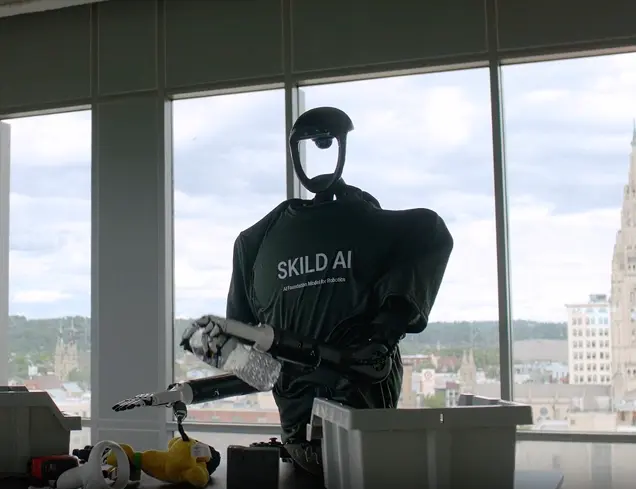
Skild AI gave a humanoid a single goal—to score—and let competition do the rest. After thousands of parallel matches in simulation, balance, speed, dribbling, defense, and team play emerged without programming each movement separately.
A Simple Command Unlocked a Complex Repertoire
The objective did not say "dribble," "run," or "maintain balance." According to Skild AI, the system only had to score. From that signal, a physical intelligence model was repeatedly pitted against versions of itself within NVIDIA Isaac Sim. Each new rival forced the agent to find better responses, while thousands of matches could run in parallel.
The company estimates that the process accumulated the equivalent of more than 140 years of simulated soccer in just a few weeks of real time. It was not 140 clock years nor a continuous run by a physical robot: it is the sum of experience produced simultaneously across many virtual environments on computing infrastructure.
At first, the agent could barely walk. With competition came getting up after a fall, accelerating, approaching the ball, orienting it, shielding it, and contesting possession. In multi-agent matches, passing and coordination also emerged. These behaviors did not receive an individual reward; they proved useful because they increased the likelihood of scoring.
What Learning Through Self-Play Means
Self-play turns the system itself into a generator of adversaries and data. One copy attempts to outperform another; the improved version becomes the next opponent, and the level of difficulty rises without relying exclusively on human demonstrations. The idea has well-known precedents in games like Go, StarCraft II, and Dota 2, but transferring it to a physical body introduces gravity, inertia, contact, latency, and the risk of damage.
In soccer, a rigid policy can solve a predicted trajectory, but it breaks down when the ball, the opponent, or the starting position changes. Competition forces a response to dynamic situations. The value of the test lies not in training a professional striker, but in demonstrating how a high-level objective can produce a set of reusable motor skills.
| Capacidad observada | Por qué resulta útil | Cómo habría emergido |
|---|---|---|
| Equilibrio y recuperación | Evita perder la jugada después de un contacto o una caída | La estabilidad permite seguir buscando el gol |
| Carrera y aceleración | Reduce el tiempo para alcanzar el balón o cerrar un espacio | La velocidad mejora la ventaja competitiva |
| Regate y control | Mantiene la pelota cerca mientras el robot cambia de dirección | Controlar la posesión aumenta las opciones de marcar |
| Protección y entrada | Permite conservar o recuperar la pelota frente a un oponente | El rival introduce presión y obliga a defender |
| Pase y coordinación | Distribuye la acción entre varios agentes | En partidos colectivos, cooperar puede superar el juego individual |
The Difficult Leap: From Simulation to the Real Floor
Simulated physics is always an approximation. Real motors, surfaces, cameras, and joints have tolerances, delays, and noise that the virtual model does not reproduce perfectly. This difference is known as the sim-to-real gap: a policy that is brilliant on screen can fail as soon as it touches a carpet or receives an unexpected push.
Skild AI claims that it transferred the trained policy to the physical humanoid without task-specific retraining and tested it against both humans and other robots. The video shows running, approaching the ball, changes of direction, and posture recovery. It is a striking demonstration of transfer, although the company did not publish alongside it a peer-reviewed paper, reproducible code, or comprehensive success rate metrics.
That is why it is advisable to separate visible evidence from a general conclusion. The robot executes physical skills learned in simulation; we still do not know how often it fails, how much its performance changes on a different surface, how dependent it is on that ball, or how it responds after hours of operation.
S1 and the ambition of a brain for many robots
The experiment relies on S1, the generalist model introduced by Skild AI to learn new tasks in context. The company's proposition is for a robot to be able to observe a demonstration and adapt it without training a separate model from scratch. This approach is part of a broader ambition: Skild Brain, a physical intelligence foundation capable of operating different bodies, from arms and mobile platforms to quadrupeds and humanoids.
Skild AI was founded in Pittsburgh in 2023 by Deepak Pathak and Abhinav Gupta, researchers affiliated with the Robotics Institute at Carnegie Mellon University. The company has attracted capital from Lightspeed, Coatue, SoftBank, Jeff Bezos, and Felicis Ventures. Aydin Senkut, founder of Felicis, has been one of its promoters; Ryan Kitchie leads the company's global commercial expansion.
The investment explains the scale of compute and also calls for a cautious reading of corporate demonstrations. A good video sequence proves that a capability exists, but it does not replace an independent benchmark, safety documentation, or sustained results in production.
Soccer is the laboratory; industry is the match
A factory, a construction site, or a kitchen has no scoreboard, fixed rules, or instant restart. To transfer self-play to those spaces, it will be necessary to build objectives that do not reward dangerous shortcuts, sufficiently varied simulations, and boundaries that protect people, products, and machinery. Useful autonomy needs to learn and, at the same time, know when to stop.
From Geniales.co and KingNews.online, we see an important clue for embodied intelligence in this demonstration: progress is not just about recognizing objects or conversing, but about turning perception, decision-making, and movement into robust behavior. Self-play can produce experience at a scale impossible for a physical laboratory, provided that experience survives contact with the real world.
The question is no longer merely whether a robot can score a goal. It is whether competing against itself can teach it the general skills it subsequently needs to carry, assemble, inspect, or assist. Skild AI shows a promising answer, still partial and pending independent verification.
What has been demonstrated and what remains to be measured
The case brings together three breakthroughs: autonomous generation of experience, the emergence of skills not prescribed one by one, and transfer from the simulator to a humanoid. Its significance lies in the combination, not in the robot playing better than a human.
There is a lack of public data on architecture, reward, number of agents, computational consumption, hardware, durability, and performance outside the demonstrated scenario. Until comparable tests exist, the 140 simulated years and direct transfer must be understood as results reported by Skild AI. They are sufficient to open a serious conversation; not to declare general physical learning solved.
Enlaces
Get KingNews in your inbox
Tech and gaming digest, no noise. Unsubscribe anytime.
Want to send us a news story?
Tell us your story. Our editorial team reviews it and gets back to you.
Would you like to advertise with us?
Write to us and we'll send you ad options and audience data.
More stories
Inteligencia física · Agricultura · Robótica industrial
Polybot enseña a un robot a cosechar tomates mirando cómo trabajan los humanos
Movilidad eléctrica · Arabia Saudita
Ceer EXOBOT: Arabia Saudita presenta su primer auto eléctrico y quiere construir una potencia automotriz
Inteligencia Artificial · Lenguas · India
¿Puede la IA preservar las lenguas de India? El mapa cultural de sus 121 idiomas
Materiales · Industria textil
Del bambú a una camiseta suave: la transformación que no siempre nos cuentan
Aviación · Robótica
Japan Airlines pone ojos autónomos sobre sus aviones

Gaming · Guía de compra