
Robotics Shanghai Stock Exchange
Unitree is worth 50,000 million on the stock market and sells 18,000 humanoids: the account does not add up
2026-08-22 · 9 min read
By Álvaro AbrilDirector de KingNews.online · CEO de Geniales.co
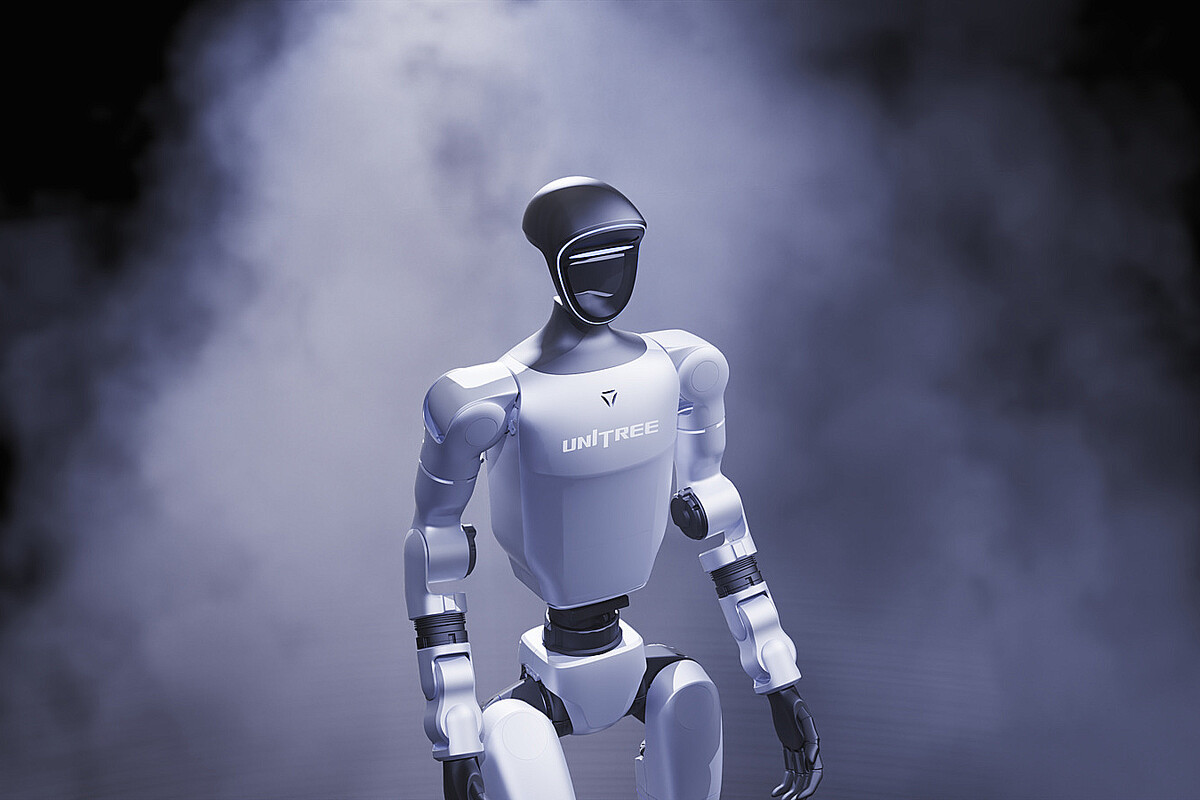
Unitree Robotics debuted in Shanghai raising $904 million, its stock rose more than 600% in the session and closed around +460%. The company is now worth about $50 billion, betting on a market—that of the useful humanoid robot—that does not yet exist.
What Exactly Is Unitree?
Unitree Robotics was founded in 2016 in Hangzhou by Wang Xingxing, an engineer who built his first robot dog—the XDog—as a master's project on an almost domestic budget. Ten years later, his company dominates the global market for affordable robotic quadrupeds: while a Boston Dynamics Spot costs around $75,000, a Unitree Go2 starts at under $1,600 and a G1 humanoid is advertised starting at $16,000. That is, in a sentence, the strategy: not to be the best robot on the planet, but the first one that fits into a normal budget.
On August 18, 2026, the company debuted on the Shanghai Stock Exchange. It raised about $904 million in its IPO, with the stock surging more than 600% during the session before closing with a gain close to 460%. Retail investor demand exceeded the available shares thousands of times over. The result: a market capitalization of around $50 billion.
The problem: the market that justifies that figure does not yet exist
Reuters puts the number of humanoid robots distributed by Unitree through July 2026 at 18,000 units. It is a remarkable figure for an emerging technology and ridiculous compared to a 50 billion valuation. Nobody is paying for today's business: they are paying for the expectation that in a few years, a humanoid will be just another industrial appliance.
Wang Xingxing himself admits it without sugarcoating. He speaks of a future "ChatGPT moment" for robotics: the day a robot understands a general instruction and executes a new task without having been specifically programmed for it. His optimistic timeframe is two or three years; the realistic one, between five and ten. Meanwhile, humanoids remain slow, expensive, and not very versatile.
Who is buying robots today: the uncomfortable fact
The Financial Times investigated the Chinese ecosystem and found that a significant portion of current demand comes from more than 90 training centers backed by local governments. These centers buy humanoids, use them to generate movement and training data, and then sell part of that data back to the manufacturers themselves.
The cycle is technically virtuous—without physical-world manipulation data there is no progress—but murky from an accounting standpoint: it makes it difficult to know what percentage of sales corresponds to clients who are actually using robots for work and what percentage is, in practice, an industrial subsidy disguised as revenue.
The Chinese pattern: manufacturing the industry before the customer
China has already executed this playbook in electric vehicles, batteries, and solar panels: the state helps create demand, finances dozens of competitors, and sustains the supply chain before the market matures. The typical result is overcapacity, a price war, and a brutal culling of companies… from which two or three survive to ultimately dominate the global market. CATL and BYD are proof.
If the pattern repeats itself, the question is not whether there will be a robotics bubble—there will be—but who is left standing when it bursts. And there, China's advantage is not software: it is having suppliers of actuators, harmonic reducers, rare-earth magnets, and battery cells less than an hour's drive from the laboratory.
| Indicador | Dato | Lectura |
|---|---|---|
| Capital captado en la OPV | ≈ 904 M USD | Una de las mayores salidas tecnológicas del año en Shanghái |
| Máximo intradía | +600% | Demanda minorista miles de veces superior a la oferta |
| Cierre del día | ≈ +460% | El mercado compra narrativa, no balance |
| Capitalización | ≈ 50.000 M USD | Comparable a fabricantes industriales consolidados |
| Humanoides distribuidos (hasta jul. 2026) | ≈ 18.000 | ≈ 2,8 M USD de valoración por robot vendido |
| Precio de entrada del G1 | desde ≈ 16.000 USD | Un orden de magnitud por debajo de sus rivales occidentales |
The irony: the science came from the United States
The fundamental ideas that allowed Unitree to build cheap, stable robot dogs came from research openly published by American universities, much of it funded by the country's military. Unitree did not steal anything: it read the papers, understood dynamic leg control, and turned it into a sellable product.
It is the difference between publishing and manufacturing. The West wrote the manual; China built the factory. That is the real headline of this IPO, not the 460%.
A View from the Gaming Industry
At KingNews.online, we are following this story for a specific reason: service robotics will reach the brick-and-mortar casino before the factory. Patrol quadrupeds in hallways, warehouse inventory units, floor attendants in Asian resorts—Macau and Singapore are already experimenting with this—and, above all, sensors and vision models that Unitree is making more affordable for the rest of the industry.
The lesson is the same one we applied when developing Jack7.co, our progressive jackpot system for live casino tables: the winning technology is not the most spectacular one in a video, but the one that lowers the cost per deployed unit until installing it ceases to be a board-level decision. Unitree has understood this far better than its rivals. Whether it is also worth 50 billion before proving it is another matter.
Our bet: the correction will come, it will be painful, and Unitree will still exist afterward. Bubbles destroy valuations; supply chains survive.
Enlaces
Get KingNews in your inbox
Tech and gaming digest, no noise. Unsubscribe anytime.
Want to send us a news story?
Tell us your story. Our editorial team reviews it and gets back to you.
Would you like to advertise with us?
Write to us and we'll send you ad options and audience data.
More stories
Robótica · Inteligencia artificial · Sistemas autónomos
La colmena blindada: robots terrestres que podrían comandar enjambres de drones
Agrotecnología · Inteligencia artificial · Ganadería
La granja autónoma toma forma: IA, drones y robots llegan al campo

Inteligencia artificial · Empresas · Opinión
BMW adelgaza su dirección con IA: ¿ha llegado la hora del gerente artificial supervisado?
Inteligencia física · Agricultura · Robótica industrial
Polybot enseña a un robot a cosechar tomates mirando cómo trabajan los humanos
Inteligencia física · Robótica · Aprendizaje autónomo
El robot de Skild AI que aprendió a jugar fútbol contra sí mismo durante 140 años simulados
Movilidad eléctrica · Arabia Saudita