
Scania · Autonomous vehicles
Scania AXL: the truck that eliminated the cab because there is no longer anyone to sit inside
2026-09-02 · 6 min read
By Álvaro AbrilCEO de Geniales.co · Director de KingNews.online
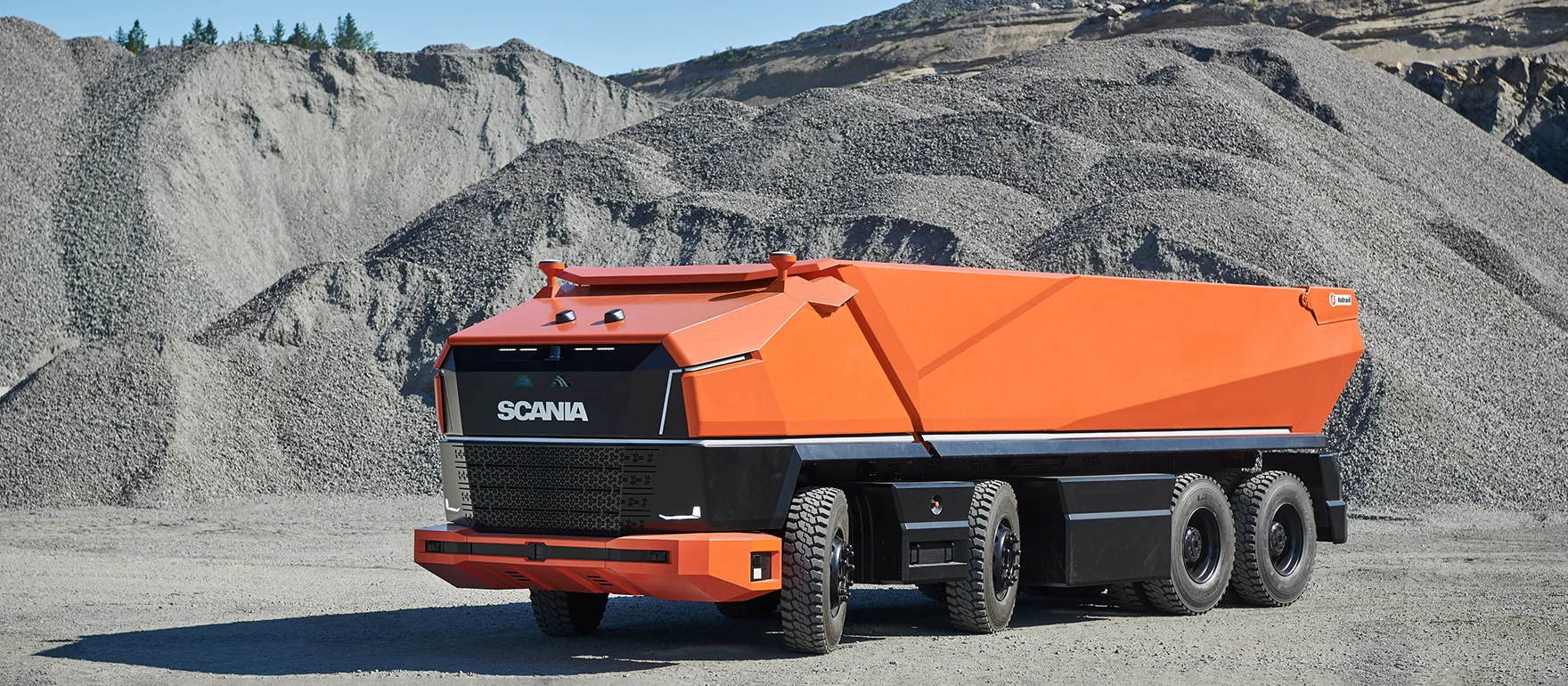
Scania introduced AXL, a fully autonomous concept truck without a driver's cab. It was created for mines and large closed construction sites, controlled environments where autonomous driving is already viable today, and where the steering wheel, mirrors, and driver's station have become dead weight.
A truck with no cab, no steering wheel, and no mirrors
Scania introduced the AXL as the latest member of its autonomous vehicle family: a fully autonomous concept truck that, unlike anything before it, has no driver's cab. There is no control station, no steering wheel, no pedals. Where the driver used to sit, there is now an intelligent front module equipped with sensors, cameras, radar, and lidar.
The industry has spent years looking for ways to make transport more efficient and more sustainable, and autonomous vehicles are featuring ever more prominently in that conversation. Mines and large closed construction sites are the natural settings for initial pilot projects: they are controlled environments with repetitive routes, managed traffic, and no random pedestrians or public road regulations.
“The development of autonomous vehicles has made great strides in recent years. We still do not have all the answers, but through concept vehicles like the Scania AXL, we are breaking new ground and continuing to learn at great speed,” says Claes Erixon, Head of Research and Development at Scania.
The video shows the AXL in its natural habitat: a quarry, uneven terrain, and repetitive loading cycles, exactly the type of operation where autonomy ceases to be a promise and becomes measurable productivity.
Software is the driver
The AXL is steered by an intelligent control system powered by the operating environment itself. In a mine, that means integrating with the site's logistics system: the control tower assigns tasks, the truck plans its route, executes the loading and unloading cycle, and reports its status in real time. The vehicle does not wait for step-by-step human orders; it waits for objectives.
Scania maintains its modular philosophy here: the AXL uses a combustion engine powered by biofuel and shares a platform with the commercial range. It is not a trade show mock-up; it is a rolling demonstrator built on production components, which significantly narrows the gap between the concept and a commercially viable version.
Eliminating the cab frees up mass, aerodynamics, and cost. It also changes maintenance: without ergonomics, climate control, airbags, or cabin homologation, the vehicle is designed around the payload and the powertrain, not around a person.
Why Mines Go First
Autonomous transport on open roads hits a regulatory and civil liability wall that no one has yet solved. In a private mine, that wall does not exist: the operator controls the terrain, the rules, and every person present. That is why Rio Tinto, BHP, and Fortescue have spent more than a decade operating autonomous haulage fleets, with thousands of robotic trucks moving ore 24 hours a day.
The economic case is compelling: continuous shifts without fatigue, optimized acceleration and braking that reduce fuel consumption and tire wear, fewer incidents due to human error, and total traceability for every ton moved. Above all, it removes people from an environment of dust, noise, vibration, and real accident risks.
| Aspecto | Camión tradicional | Scania AXL |
|---|---|---|
| Cabina | Obligatoria, con toda su homologación | Inexistente |
| Operación | Turnos limitados por fatiga | Ciclos continuos |
| Control | Conductor a bordo | Sistema logístico del sitio |
| Entorno objetivo | Vía pública y sitios cerrados | Minas y obras cerradas |
| Propulsión | Diésel / biocombustible | Combustión con biocombustible |
What this anticipates
Scania is not selling the AXL: it is learning from it. Every kilometer in the quarry feeds the perception, planning, and safety models that will later trickle down into real products. It is the same strategy gaming technology manufacturers followed when they tested cashless and management systems in their own venues before commercializing them: validation happens through real-world operations, not demos.
The interesting question is not when we will see an AXL on the highway, but rather how many vehicle categories will disappear when the driving cab ceases to be a design requirement. Ports, logistics hubs, large-scale agriculture, and forestry share the exact same conditions of a closed environment and repetitive cycles.
And there is a cultural detail that is often overlooked: when a vehicle loses its human face, its visual language changes as well. The front end of the AXL, with its faceted geometry and sensor strip, is the new way of saying “this machine sees you.”
Enlaces
Get KingNews in your inbox
Tech and gaming digest, no noise. Unsubscribe anytime.
Want to send us a news story?
Tell us your story. Our editorial team reviews it and gets back to you.
Would you like to advertise with us?
Write to us and we'll send you ad options and audience data.
More stories
Comercio electrónico · Eventos · Colombia
Feria Effix 2026: Medellín se convierte en la capital del comercio electrónico
Robótica · Inteligencia artificial · Sistemas autónomos
La colmena blindada: robots terrestres que podrían comandar enjambres de drones
Agrotecnología · Inteligencia artificial · Ganadería
La granja autónoma toma forma: IA, drones y robots llegan al campo

Inteligencia artificial · Empresas · Opinión
BMW adelgaza su dirección con IA: ¿ha llegado la hora del gerente artificial supervisado?
Inteligencia física · Agricultura · Robótica industrial
Polybot enseña a un robot a cosechar tomates mirando cómo trabajan los humanos
Inteligencia física · Robótica · Aprendizaje autónomo