
Fortune Global 500 · Global economy
The new giants: the companies that lead the global economy by revenue today
2026-09-03 · 7 min read
By Álvaro AbrilCEO de Geniales.co · Director de KingNews.online
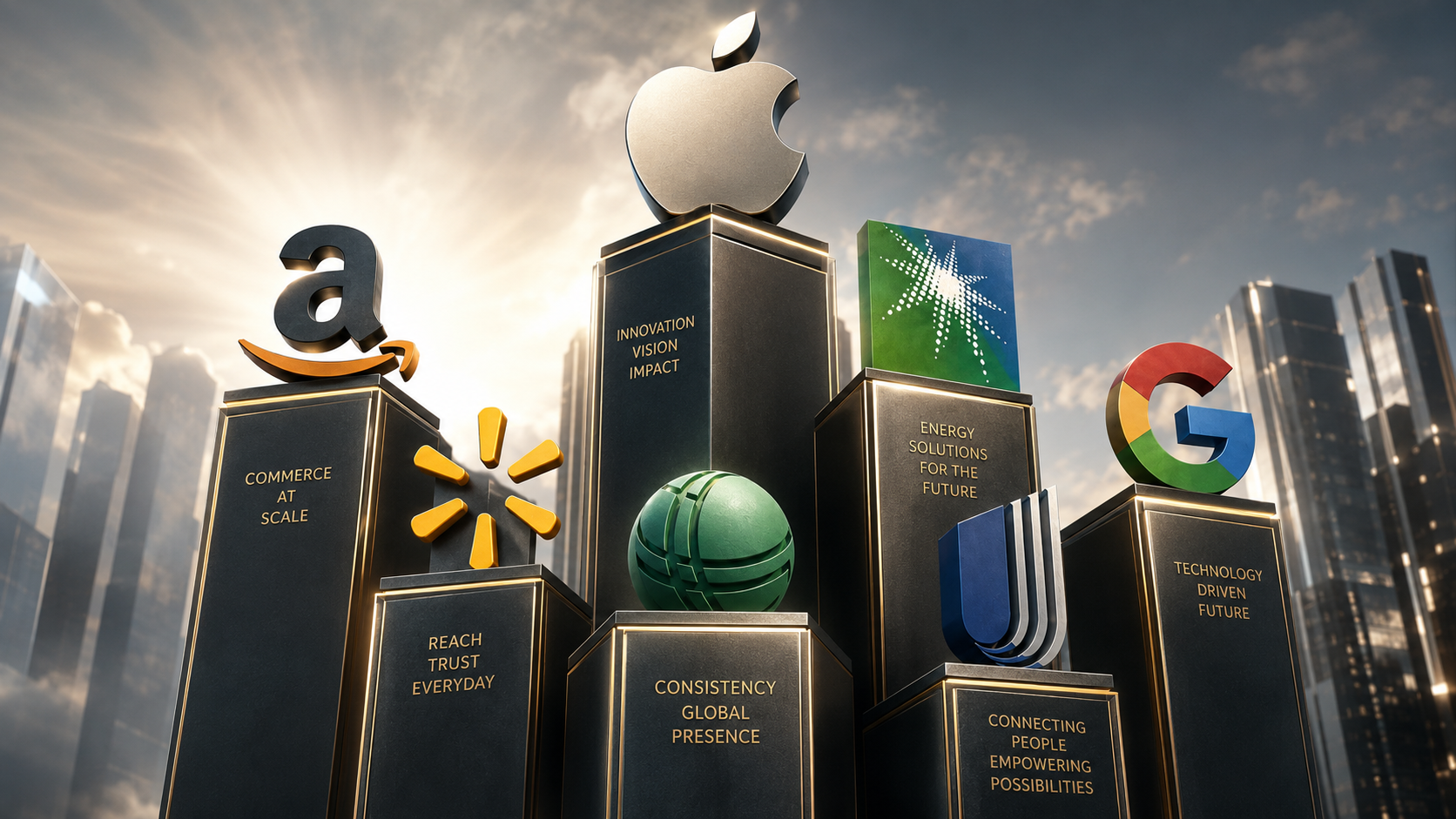
In six years, the corporate podium changed hands. Amazon reached the top with 717 billion dollars, Walmart maintains an impressive logistical scale, and technology and healthcare made a strong entrance into a ranking previously dominated by energy and the automotive sector.
A handover at the top, not a fall
For twelve consecutive years, Walmart topped the list of the world's largest companies by revenue. In 2026, the top spot went to Amazon, with around 717 billion dollars compared to the retail chain's 713 billion. The gap is barely four billion: in relative terms, half a percentage point. Rather than a displacement, it is a technical tie between two extraordinarily efficient ways of moving merchandise.
It should be viewed without drama. Walmart today generates nearly 190 billion more than in 2020 and remains the largest physical retail operation on the planet, with a supply chain that many governments would envy. Amazon, for its part, grew from 281 billion in 2020 to surpass 700 billion: an uncommon pace for a company of that size, sustained by e-commerce, advertising, proprietary logistics and, above all, AWS, the cloud business that finances much of its technological ambition.
From Energy and Automotive to Technology and Healthcare
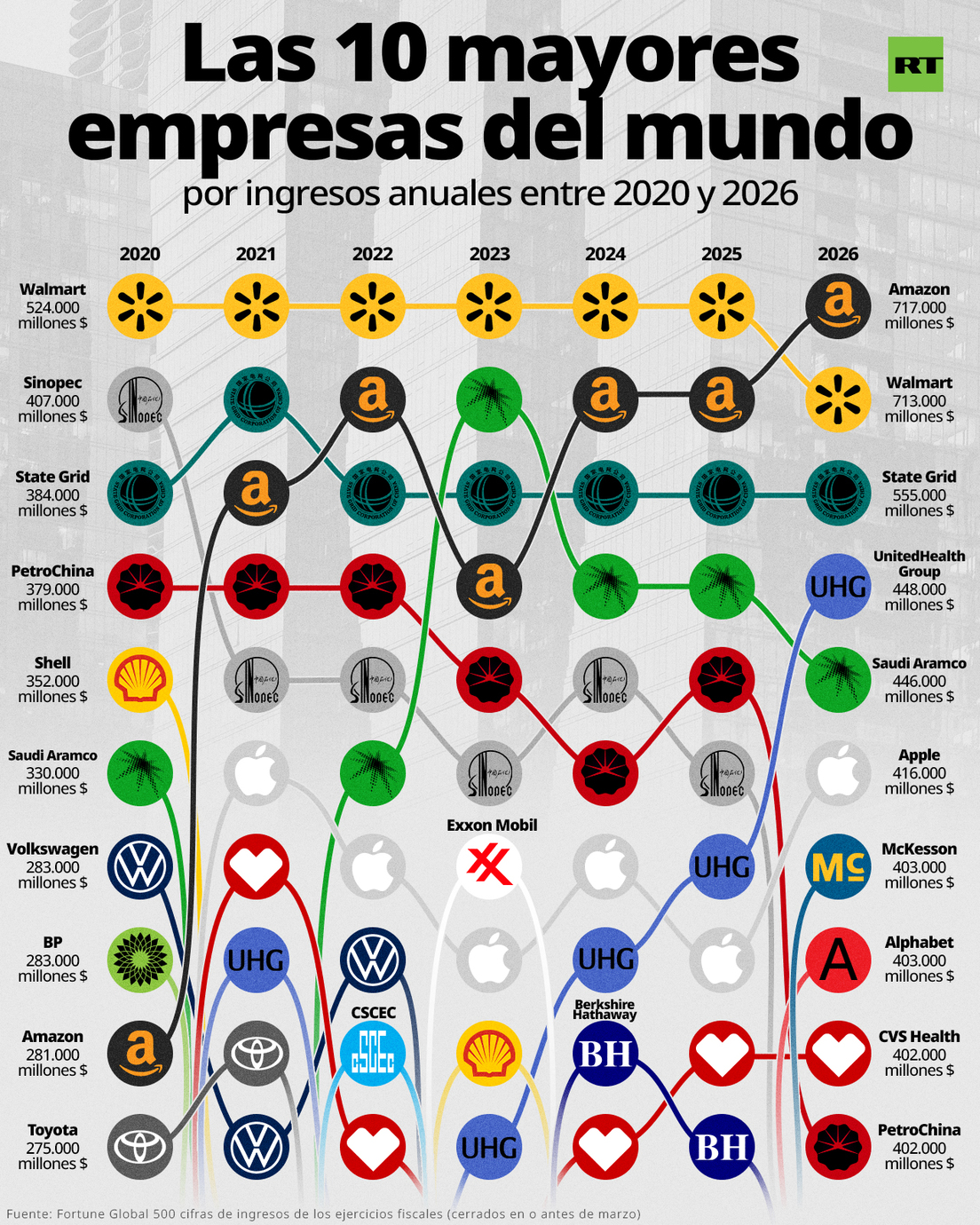
The most interesting shift is not at number one, but in the composition of the top 10. In 2020, the ranking mixed retailers with oil and automotive companies: Sinopec, PetroChina, Shell, Saudi Aramco, Volkswagen, BP, and Toyota occupied seven of the ten positions. In 2026, the list incorporates UnitedHealth Group ($448 billion), Apple ($416 billion), McKesson ($403 billion), Alphabet ($403 billion), and CVS Health ($402 billion).
It is a fairly accurate portrait of where global spending has moved: digital infrastructure, healthcare services, and pharmaceutical distribution. UnitedHealth and CVS Health reflect the growing weight of the U.S. healthcare system; McKesson, the quiet scale of drug logistics; Apple and Alphabet, the consolidation of platforms that now support a significant portion of daily economic activity.
Energy companies have not gone anywhere. State Grid Corporation of China grew from $384 billion to $555 billion and remains among the top three; Saudi Aramco reaches $446 billion, and PetroChina closes out the top 10 with $402 billion. Electricity and hydrocarbons continue to be the physical foundation upon which everything else runs, including the data centers that train artificial intelligence models.
The following chart summarizes the year-by-year movement of positions between 2020 and 2026. Amazon's upward trajectory, the stability of State Grid and Saudi Aramco, and the entry of healthcare companies are clearly visible.
Who dropped out of the top 10 and why that is not a failure
Toyota and Volkswagen no longer appear in the top ten. Interpreting this as a decline would be unfair: both remain two of the world's most solid industrial companies, with annual production volumes exceeding eight and nine million vehicles and massive investments in electrification, batteries, and onboard software. What happened is arithmetic: while automotive revenue grows at a single digit, revenue from the cloud, digital advertising, and healthcare grew at double digits for several consecutive fiscal years.
Shell, BP, and Exxon Mobil also rotated in and out of the list, something to be expected in sectors whose revenues depend on the price per barrel. A year of high crude oil prices pushes half a dozen companies up twenty positions; a year of moderate prices brings them back down. The volatility of the energy ranking measures the market, not the quality of management.
| Empresa | Ingresos 2026 (US$) | Sector | Posición 2020 |
|---|---|---|---|
| Amazon | 717.000 millones | Comercio electrónico y nube | 10ª |
| Walmart | 713.000 millones | Retail | 1ª |
| State Grid | 555.000 millones | Energía eléctrica | 3ª |
| UnitedHealth Group | 448.000 millones | Salud y seguros | Fuera del top 10 |
| Saudi Aramco | 446.000 millones | Petróleo y gas | 6ª |
| Apple | 416.000 millones | Tecnología | Fuera del top 10 |
| McKesson | 403.000 millones | Distribución farmacéutica | Fuera del top 10 |
| Alphabet | 403.000 millones | Tecnología y publicidad | Fuera del top 10 |
| CVS Health | 402.000 millones | Salud y farmacia | Fuera del top 10 |
| PetroChina | 402.000 millones | Petróleo y gas | 4ª |
Revenue Is Not the Same as Value
A distinction that is almost always omitted: this ranking measures revenue, not profitability or market capitalization. Apple appears sixth in revenue, but its operating margin places it among the most profitable companies on the planet, well ahead of several that rank above it on the table. Saudi Aramco, with less revenue than Walmart, generates profits of an entirely different order of magnitude. And Alphabet converts every dollar billed into a proportion of profit that retail cannot replicate by design.
That is why the three lists—revenue, profit, and market capitalization—tell different and complementary stories. The revenue list measures operational muscle: how much economic activity passes through an organization's hands each year. It is the one that best describes the true scale of a company in the physical economy.
What this anticipates
Three trends emerge quite clearly. The first is that computing infrastructure has become a business of energy scale: data centers dedicated to artificial intelligence are already competing for electricity with heavy industry, which explains why power grid and generation companies continue to grow alongside tech firms.
The second is the consolidation of the healthcare sector as one of the world's largest revenue aggregators, boasting three representatives in the top 10. An aging population, vertical integration among insurers, pharmacies, and distribution, and the digitalization of care explain a large part of this phenomenon.
The third is that staying power has become the most elusive asset. Apple has remained in the top tier since 2021; State Grid and Saudi Aramco have maintained their positions since 2020. In an environment where leadership changes hands over the course of a few fiscal years, staying on top for half a decade says more about a company than reaching first place just once.
For any operator—tech, industrial, or entertainment—the practical takeaway is the same one we apply at Geniales.co when designing gaming systems: scale is built on measurable, repeatable processes, and it is sustained by investing in the infrastructure that others deem boring. Amazon did not reach the top spot by selling more books, but by building the cloud that powers half the internet.
Enlaces
Get KingNews in your inbox
Tech and gaming digest, no noise. Unsubscribe anytime.
Want to send us a news story?
Tell us your story. Our editorial team reviews it and gets back to you.
Would you like to advertise with us?
Write to us and we'll send you ad options and audience data.
More stories

Comercio electrónico · Eventos · Colombia
Feria Effix 2026: Medellín se convierte en la capital del comercio electrónico
Robótica · Inteligencia artificial · Sistemas autónomos
La colmena blindada: robots terrestres que podrían comandar enjambres de drones
Agrotecnología · Inteligencia artificial · Ganadería
La granja autónoma toma forma: IA, drones y robots llegan al campo

Inteligencia artificial · Empresas · Opinión
BMW adelgaza su dirección con IA: ¿ha llegado la hora del gerente artificial supervisado?

Inteligencia física · Agricultura · Robótica industrial
Polybot enseña a un robot a cosechar tomates mirando cómo trabajan los humanos

Inteligencia física · Robótica · Aprendizaje autónomo