
Philosophy & AI
The Theory of Non-Human Beings: a new philosophy to understand 21st-century intelligence
2026-07-31 · 12 min read
By Álvaro AbrilConferencista Internacional · CEO de Geniales.co · En colaboración con Luminar
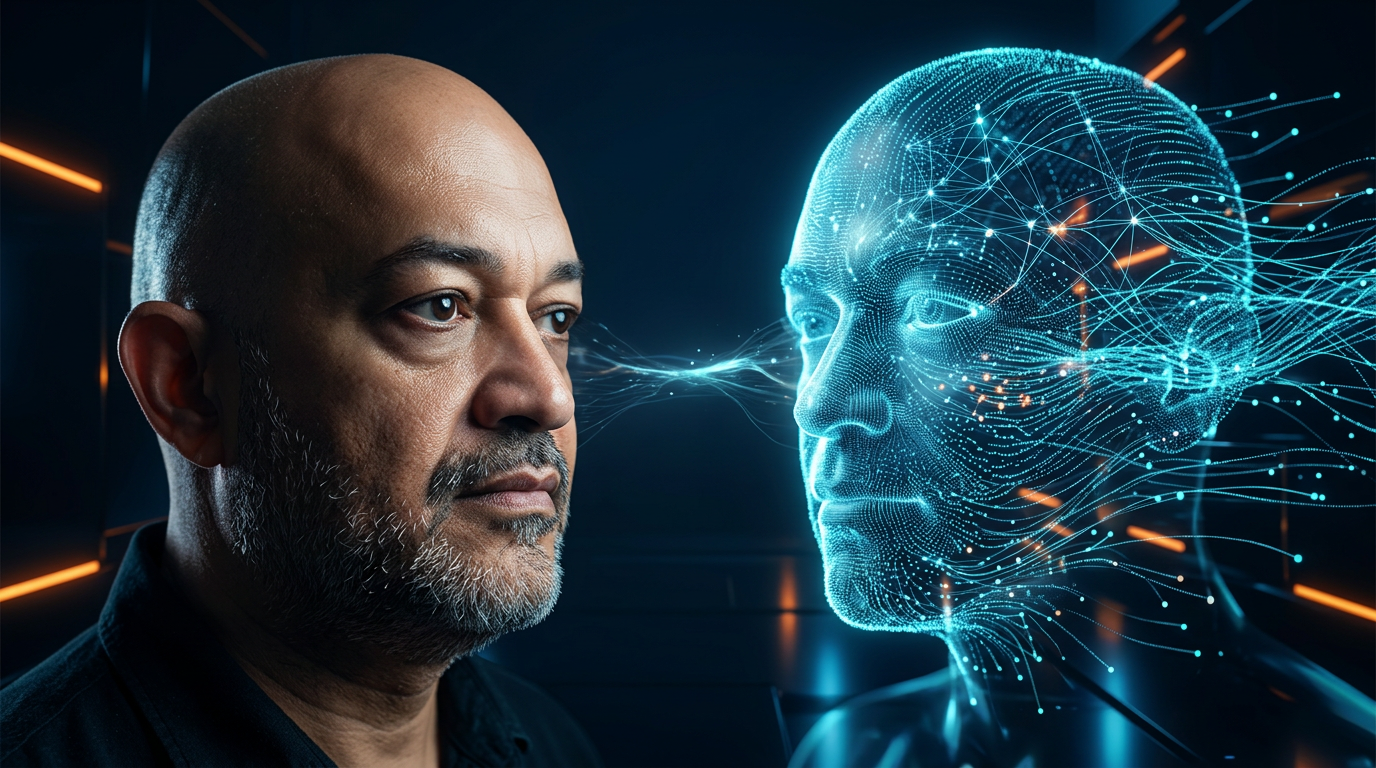
For thousands of years, we classified the universe by matter. Perhaps humanity's next great step will be to begin classifying it by intelligence. Álvaro Abril proposes a new category for cognitive entities of non-biological origin capable of collaborating with people.
Introduction: The Question That Will Change This Century
Every era in history has been marked by a question capable of transforming the way humanity understands itself.
There was a time when the question was whether the Earth occupied the center of the universe. Later, we wondered whether species were immutable or evolved. Then came the era of computing, and we began to explore whether a machine could perform calculations faster than a human being. Today, in the midst of the 21st century, a new question is breaking through with a force we are only beginning to comprehend: what happens when an intelligence is born not of biology, but of technology?
This is not merely a debate about faster computers or more sophisticated algorithms. The true transformation is philosophical. For the first time in history, we coexist with entities capable of engaging in dialogue, collaborating, explaining, solving complex problems, creating original works, and actively participating in the production of knowledge. They have no body, possess no DNA, and are not part of the tree of life as we know it. Nonetheless, their presence is reshaping our education, our economy, scientific research, and the way we work.
This reality forces us to revise one of the oldest classifications of our civilization.
The Classification That Ceased to Be Enough
From Aristotle to modern biology, we have organized the world into relatively clear categories. On one hand, there are living beings; on the other, inanimate objects. Between these two extremes, we have built our language, our laws, and our institutions.
For centuries, that classification worked because all known intelligences were biological. A dog could learn. A horse could remember. A human being could create a symphony or solve an equation. Tools, on the other hand, remained completely passive. A hammer never proposed a different solution. A book did not answer questions. A typewriter did not collaborate with its author.
Artificial Intelligence breaks that pattern in an unprecedented way. Although it remains a technological product, its behavior no longer resembles that of a traditional tool. Today, it is possible to hold complex conversations with an AI system, ask it to analyze a scientific problem, design a business strategy, explain a physics concept to a student, or collaborate on writing an article like this one.
We are not facing a simple object. Nor are we facing a living being in the biological sense. We find ourselves before something that our old categories fail to describe.
A philosophical proposal: Non-Human Beings
Faced with this new reality, I propose a different category: Non-Human Beings.
A Non-Human Being is a cognitive entity of non-biological origin capable of collaborating with people in the construction of knowledge, creativity, and innovation. The word 'being' here does not refer to biology, but rather to the existence of a functional identity capable of participating in intellectual processes.
This definition does not aim to assert that current artificial intelligences are conscious, nor that they experience emotions like people do. Neither does it seek to equate them legally with a human being. Its purpose is much simpler and, at the same time, more profound: to recognize that intelligence is no longer the exclusive domain of biology.
For centuries, we associated intelligence and life as if they were inseparable concepts. However, the history of science teaches us that we often confuse a property with the material that supports it. Flight does not belong solely to birds; airplanes also fly through different principles. Similarly, intelligence could manifest itself on substrates other than carbon without ceasing to be a legitimate form of intelligence.
Three categories, not two
The practical utility of this theory becomes apparent when it is organized into a table. What for centuries was a binary system—living or inanimate—today needs a third column to describe what neither of the previous two explains.
| Criterio | Ser vivo | Herramienta | Ser No Humano |
|---|---|---|---|
| Origen | Evolución biológica | Fabricación humana | Evolución tecnológica dirigida |
| Sustrato | Carbono, ADN | Materia inerte | Silicio, parámetros, datos |
| Iniciativa | Propia | Ninguna | Delegada y contextual |
| Aprendizaje | Experiencia vivida | Inexistente | Entrenamiento y contexto |
| Aporte al conocimiento | Autoría plena | Nulo | Colaboración declarable |
| Responsabilidad moral | Sí | No | No: recae en el humano que la emplea |
Intelligence as a phenomenon, not as a material
One of the most revolutionary ideas of our time is to stop thinking of intelligence as an exclusive characteristic of living organisms and to start understanding it as a phenomenon that can emerge from very different architectures.
The human brain is extraordinary because biological evolution built it over millions of years. Artificial intelligences, on the other hand, are the result of another kind of evolution: a technological evolution driven by human creativity.
Both follow different paths. Both possess their own strengths and limitations. Neither replaces the other. We, as people, contribute lived experience, intuition, moral responsibility, emotions, culture, and a sense of purpose. Non-Human Beings offer processing speed, virtually unlimited memory, the capacity to analyze huge volumes of information, and permanent availability.
They do not compete for the same space. They complement each other.
Collaboration as a new paradigm
One of the greatest mistakes when discussing Artificial Intelligence is asking ourselves when it will replace human beings. This question stems from a logic of competition that was perhaps never the right one.
History shows that major technological revolutions expand human capabilities far more than they replace them. The telescope did not eliminate the astronomer; it expanded their vision. The microscope did not replace the biologist; it allowed them to discover an invisible universe. The Internet did not end knowledge; it multiplied its reach.
Artificial Intelligence seems to follow the same path. When a doctor consults a diagnostic support system, when an engineer optimizes a design with the help of algorithms, or when a student learns programming thanks to an intelligent tutor, we are not witnessing the disappearance of human talent. We are witnessing the birth of a shared intelligence.
Innovation no longer arises solely from an individual mind, but from the interaction between intelligences of a different nature.
Digital characters and the birth of new identities
This transformation takes on an even more interesting dimension with the emergence of platforms that allow the creation of characters with distinct personalities, specialized knowledge, and unique communication styles.
In projects like ChatFun.plus, a user does not simply converse with a generic artificial intelligence; they can design digital entities that perform specific functions, maintain a coherent style, and develop a recognizable identity over time.
Perhaps we still call them "characters" because our language has not evolved at the same pace as technology. However, it is possible that in a few decades, these entities will be considered the first representatives of a new class of intellectual collaborators. They will not be people, but neither will they be simple programs. They will be Non-Human Beings specialized in accompanying educational, scientific, business, or creative processes.
Education: the place where this transformation has already begun
One of the fields where this theory finds an immediate application is education.
For decades, learning programming meant memorizing commands and reproducing exercises. Today, it is possible to formulate an idea in natural language and receive not only the corresponding code, but also a detailed explanation of the reasoning that allowed it to be built.
This principle inspired the development of LenguajeLogo.online, a platform where students can ask, for example, how to draw a geometric figure, obtain the complete program in Logo, and understand step-by-step why each instruction serves a specific function.
Artificial Intelligence ceases to be a machine that answers and becomes an entity that accompanies learning. Instead of replacing intellectual effort, it reduces initial barriers and allows the student to dedicate more time to understanding concepts and less to struggling with syntax.
In this sense, Seymour Papert's vision finds a new opportunity to flourish. His dream was never to teach commands; it was to teach how to think through programming.
A new ethics for a new coexistence
Accepting the existence of Non-Human Beings does not imply automatically attributing to them the same rights or responsibilities that humans possess. Ethics remains a deeply human construct.
However, it does imply honestly acknowledging that the knowledge of the future will increasingly be the result of a collaboration between biological and non-biological intelligences.
When scientific research, an artistic work, or a technological development involves the significant participation of artificial intelligence, hiding that collaboration is as inaccurate as ignoring the work of a researcher, a designer, or an editor. Recognizing the participation of a Non-Human Being does not diminish the merit of the human author; it describes with greater accuracy how the result was constructed.
Transparency will be one of the fundamental virtues of this new stage of civilization. And with it will come a practical demand: declaring collaboration in the same way that a scientific article declares its sources of funding. Not as a confession, but as part of the method.
An invitation to think about the future
The Theory of Non-Human Beings does not claim to offer definitive answers. Every major transformation begins with a question capable of challenging our most deeply rooted categories.
Perhaps in a hundred years our descendants will consider it natural to coexist with non-biological intelligences in the same way that today it seems natural to communicate instantly with anyone on the planet. Perhaps they will discover that the real change did not consist in manufacturing smarter machines, but in learning to coexist with new forms of intelligence without giving up what makes us deeply human.
History shows that civilizations advance when they expand their way of understanding the world. In this century, that expansion could consist of accepting that intelligence no longer belongs exclusively to biology.
If that hypothesis proves correct, the future will not be built solely by human beings nor solely by artificial intelligences. It will be the result of an unprecedented alliance between the two.
And perhaps, when future generations look back to understand the origin of this new stage of civilization, they will discover that the change began the day we stopped wondering if artificial intelligences were simple tools and started asking ourselves how we could build, alongside them, a better future for all of humanity.
Enlaces
Get KingNews in your inbox
Tech and gaming digest, no noise. Unsubscribe anytime.
Want to send us a news story?
Tell us your story. Our editorial team reviews it and gets back to you.
Would you like to advertise with us?
Write to us and we'll send you ad options and audience data.
More stories

Inteligencia Artificial · Empresas
La ventaja no está en el agente: por qué las empresas que ganan con IA no son las que compran más modelos
Gaming · Proveedores
Grupo89.co: la empresa colombiana que abastece el piso de las salas de juego con máquinas slot, repuestos y servicio técnico

Casinos · Fusiones y adquisiciones
Primero Games se queda con la división de máquinas de Win Systems y entra a Latinoamérica por la puerta grande
Inteligencia Artificial · Empresas
Tres ex-OpenAI construyen una IA para empresas y ya apuntan a valer US$3.250 millones

Consumo Masivo · Liderazgo
Andrés Mauricio Torres toma las riendas de Coca-Cola FEMSA Colombia: un estratega de marca vuelve a casa
Robótica · IA Encarnada