
Aviation · Robotics
Japan Airlines puts autonomous eyes on its aircraft
2026-09-14 · 8 min read
By Álvaro AbrilCEO de Geniales.co · Director de KingNews.online
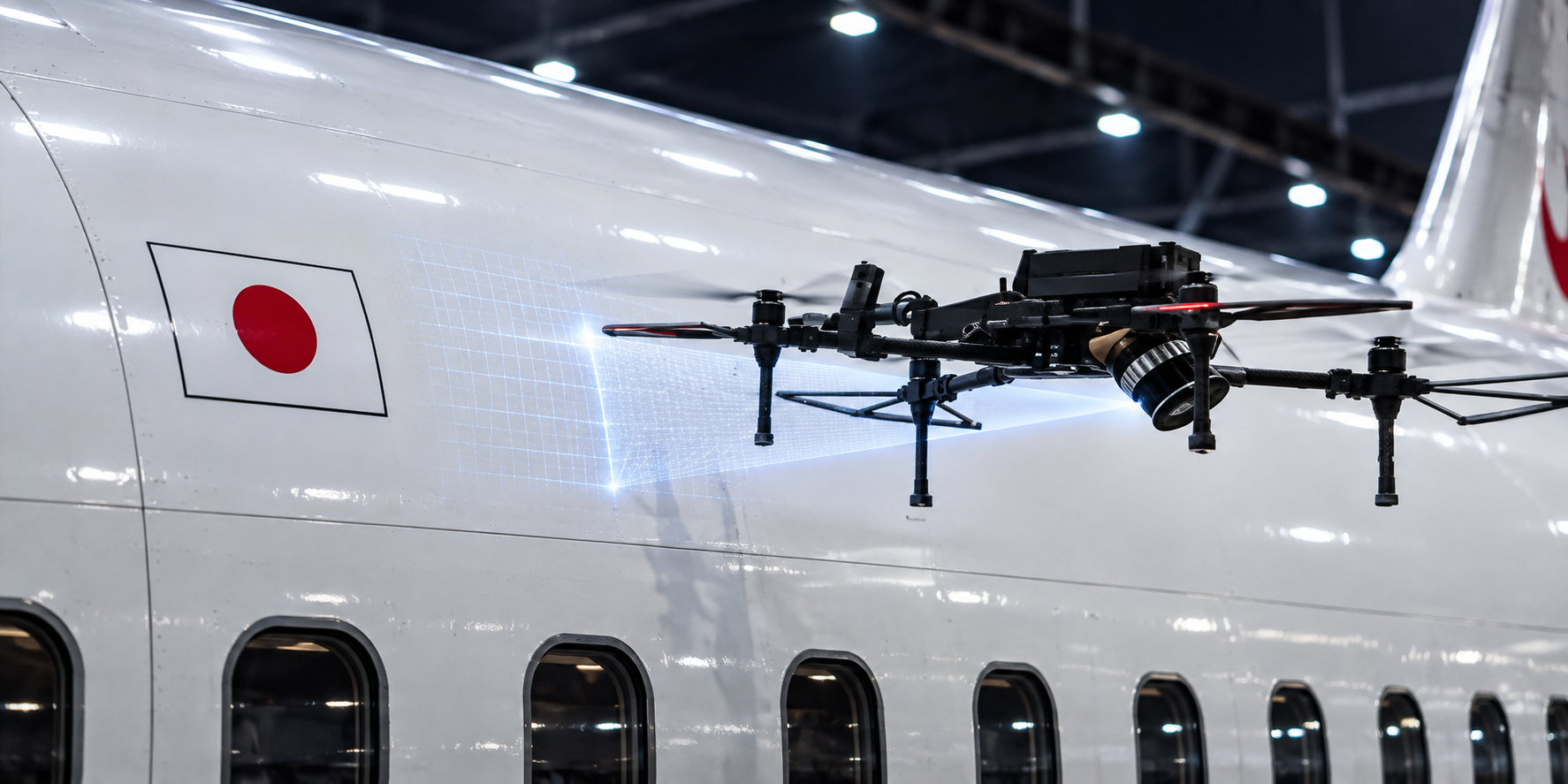
Japan Airlines and JAL Engineering are testing Donecle's Iris GVI at Haneda, a drone capable of scanning a Boeing 737-800 without GPS, capturing between 800 and 900 images, and turning hours of exterior inspection into an orderly, repeatable visual record. It does not replace the technician: it gives them better eyes and keeps them off heights.
A drone that learns the shape of the airplane
Japan Airlines —JAL— and its maintenance subsidiary JAL Engineering have begun testing a different way of inspecting the exterior of their aircraft at Tokyo-Haneda Airport. The centerpiece is Iris GVI, a platform created by the French company Donecle to carry out fully autonomous flights inside the hangar.
The public demonstration was conducted on a Boeing 737-800. In a full inspection, the system can produce between 800 and 900 photographs of approximately 24 megapixels. Each shot is linked to an area of the aircraft, making it easier to compare findings and preventing the outcome from depending solely on each individual's visual sweep.
Since satellite signals are unreliable inside a hangar, the equipment navigates using LiDAR, proximity sensors, and a preprogrammed flight path. It detects obstacles, maintains a safe distance from the fuselage, and does not require a pilot to manually steer each movement.
From Five or Ten Hours to a Much Shorter Inspection
A traditional visual inspection can take between five and ten hours, depending on the aircraft model and the task. JAL's tests place the automated route and image review within an approximate range of two to three hours. The airline estimates a reduction of nearly 60% in man-hours, although it cautions that the two processes are not yet equivalent across all tasks.
The difference does not lie solely in flying faster. The drone records a consistent sequence, covers defined areas, and leaves high-resolution photographic evidence. Two operators can supervise the flight, and typically, one person can review the captured material afterward.
That savings has a significant operational impact: an aircraft spends less time under inspection, and maintenance teams can devote more attention to diagnostics, repairs, and preventive tasks. However, moving the aircraft to the hangar and closing the doors can add one or two hours to the process; the real benefit must be measured across the entire operation, not just with the drone's stopwatch.
| Etapa | Método convencional | Prueba con Iris GVI |
|---|---|---|
| Recorrido exterior | Técnicos, plataformas y trabajo en altura | Vuelo autónomo con ruta programada |
| Duración estimada | Entre 5 y 10 horas | Entre 2 y 3 horas |
| Registro | Observaciones y fotografías tomadas por el equipo | Entre 800 y 900 imágenes organizadas por zona |
| Decisión final | Técnico de mantenimiento | Técnico de mantenimiento |
Donecle: a company born to inspect fuselages
Donecle was founded in 2015 in the Toulouse region, one of Europe's major aeronautical hubs. Instead of adapting a consumer drone, it focused its product on a specific problem: inspecting aircraft surfaces with a repeatable process compatible with maintenance procedures.
Its Iris GVI system is included in Airbus and Boeing maintenance documentation, and holds regulatory recognitions linked to the US FAA and the European EASA. That integration is decisive: in aviation, it is not enough for a camera to be able to see damage; the tool and the procedure must fit into a certified, traceable, and auditable environment.
The company had already brought its technology to maintenance organizations such as AAR and Jet Aviation. In April 2026, it announced a 10 million euro funding round to accelerate its international expansion, including Asia. The collaboration with JAL places that strategy in one of the world's most demanding aeronautical markets.
Automation Does Not Sign Off on Airworthiness
The drone captures data; it does not replace professional judgment. At the current stage, a technician examines the images, determines whether a mark corresponds to dirt, paint, a dent, a crack, or another sign, and decides whether an additional inspection or repair is required. Responsibility for the condition of the aircraft remains human.
That division of tasks is precisely the most sensible. The machine can repeat a route without fatigue, bring a camera close to elevated areas, and maintain a visual record. The specialist provides context: understanding loads, materials, tolerances, previous repairs, and operational consequences. Automating capture frees up expertise; it does not eliminate it.
It also improves occupational safety. Fewer trips over platforms, ladders, and structures around the aircraft mean less exposure to falls and impacts, especially during extensive inspections or those conducted after weather events.
Lightning, paint, and predictive maintenance
JAL is evaluating the system about four times a month. Upcoming use cases include monitoring paint condition, searching for potentially detached parts, and post-lightning strike inspections. Having comparable images of the same aircraft over time also opens the door to detecting gradual changes before they turn into major interventions.
There are concrete limits. Lightning inspection with Iris GVI is currently included in the maintenance manual for the Airbus A320 family, but not in that of the Boeing 737-800 used in the demonstration nor JAL's 777. The technical utility exists; authorization for each model and procedure must advance at the same pace.
Current tests are conducted inside the hangar with the doors closed. JAL is working with Japan's Ministry of Land, Infrastructure, Transport and Tourism to study outdoor operations, a much more complex scenario due to wind, airport traffic, communications, and regulation.
JAL and JAL Engineering: Operation and Maintenance Under the Same Test
Japan Airlines provides the operational scale and availability demands of an international airline. JAL Engineering contributes the MRO—maintenance, repair, and overhaul—expertise required to determine whether the images are truly useful within a workshop procedure, not just in a technological demonstration.
That combination explains why the trial began with operator training in March 2026, continued with flights over real aircraft in late June, and culminated in a public presentation on September 11. It is not a matter of buying a drone and turning it on, but of designing protocols, responsibilities, acceptance criteria, and a safe integration with Haneda's operations.
JAL has not yet announced a definitive date for operational use. Caution is part of the process: aviation adopts technology when it can demonstrate not only speed, but repeatability, traceability, and safety.
Better Eyes for a Human Decision
The most powerful image is not that of the drone flying alongside the aircraft. It is that of the technician sitting in front of hundreds of organized, zoomable, and comparable photographs, without having spent hours traversing the fuselage at height. That is where the shift becomes clear: automating observation to elevate the quality of decision-making.
If the trial overcomes its regulatory and operational constraints, the next leap will be connecting that visual archive with maintenance histories and models capable of pointing out variations. Predictive maintenance is not born from an isolated photograph, but from recognizing how a surface changes between inspections.
Aviation is not shifting from human eyes to drones. It is adding autonomous eyes to human expertise. And in an industry where every minute on the ground counts, that alliance can be far more valuable than either capability on its own.
Enlaces
Get KingNews in your inbox
Tech and gaming digest, no noise. Unsubscribe anytime.
Want to send us a news story?
Tell us your story. Our editorial team reviews it and gets back to you.
Would you like to advertise with us?
Write to us and we'll send you ad options and audience data.
More stories

Ciencia ficción · Conciencia · Futuros posibles
¿Y si ya estuvieras viviendo otra vida?

Gamificación · Fidelización · Marketing interactivo
GenerativeGames.online: juegos a medida que convierten clientes ocasionales en una comunidad fiel

Opinión · Automatización · Política fiscal
Que los robots también coticen: por qué la automatización necesita reglas fiscales, no prohibiciones

Economía · Inteligencia artificial · Futuro del trabajo
Microsoft ofrece salidas voluntarias a 60.000 empleados: qué hay detrás de la cifra y qué abre para las startups
Comercio electrónico · Eventos · Colombia
Feria Effix 2026: Medellín se convierte en la capital del comercio electrónico
Robótica · Inteligencia artificial · Sistemas autónomos