
Materials · Textile industry
From bamboo to a soft T-shirt: the transformation they don't always tell us about
2026-09-14 · 8 min read
By Álvaro AbrilCEO de Geniales.co · Director de KingNews.online
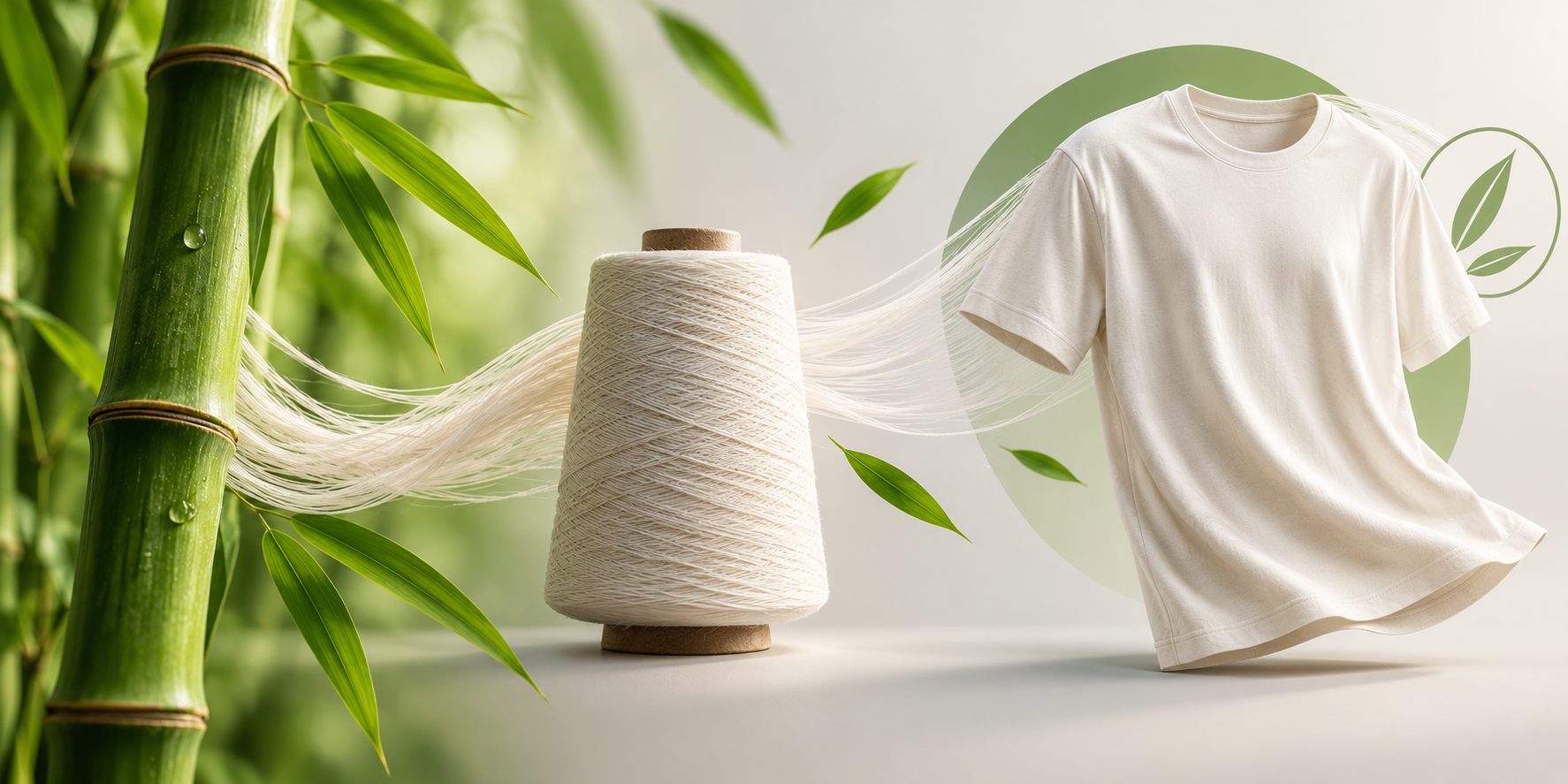
Bamboo grows quickly and can be transformed into a light, cool, and pleasant fabric. But between the plant and the garment lies a considerable chemical transformation: most of the so-called ‘bamboo fiber’ is rayon or viscose obtained from regenerated cellulose. Understanding this journey makes it possible to separate innovation, comfort, and real sustainability from an alluring label.
Green Cane Is Not Spun Like Cotton
The story is often told as an almost magical sequence: the bamboo is cut, its fibers are extracted, and a silk-like T-shirt emerges. The reality is more interesting. Bamboo contains cellulose, but also lignin, hemicelluloses, and a woody structure that must be broken down before forming a fine yarn.
Mature canes are harvested, fragmented, and processed to obtain dissolving pulp with a high cellulose content. At this stage, much of the lignin and other substances are removed. The pulp can be dried and transported to another plant, meaning that cultivation, pulp manufacturing, spinning, and garment making do not necessarily take place in the same country.
The rapid growth of some species, their regeneration from rhizomes, and the ability to cultivate them with minimal irrigation make bamboo appealing. However, these agricultural advantages do not in themselves certify the sustainability of the finished garment: the origin of the forest, biodiversity, transportation, and, above all, how the pulp is converted into fiber also matter.
The dominant path: bamboo viscose or rayon
The vast majority of soft fabrics sold as ‘bamboo’ do not retain long natural fibers from the cane. It is viscose—also called rayon—manufactured from cellulose derived from bamboo. The pulp is treated with sodium hydroxide and, in the conventional process, with carbon disulfide to form a viscous solution.
That solution is filtered and pushed through spinnerets with microscopic holes. Upon entering an acid bath, the cellulose solidifies again into thousands of continuous filaments. They are then washed, stretched, and cut or bundled according to the required yarn. That is where the uniform and soft texture that the stalk never had emerges.
The process can produce an excellent material, but it requires rigorous controls. Carbon disulfide is hazardous to workers and the environment if a plant does not capture it properly; effluents and sulfur compounds must also be recovered or treated. That is why two T-shirts bearing the same word ‘bamboo’ can have very different environmental footprints.
Lyocell and mechanical fiber: they are not the same
Another route is bamboo lyocell. Instead of converting cellulose into xanthate as occurs with conventional viscose, it usually dissolves it with N-methylmorpholine N-oxide—NMMO—and regenerates it afterward. Modern facilities operate in a closed loop and recover a very high proportion of the solvent. It is a promising alternative, although it still requires energy, water, process control, and responsible pulp.
There is also bamboo fiber obtained mechanically or enzymatically, similar in concept to linen: the fibers are separated from the stalk without completely dissolving the cellulose. It is less common, more expensive, and typically coarser. When a garment is very smooth, fluid, and silky, it is most likely a regenerated fiber and not coarse bamboo processed mechanically.
| Material | Cómo se obtiene | Qué conviene comprobar |
|---|---|---|
| Viscosa o rayón de bambú | La celulosa se transforma químicamente y se regenera | Captura de químicos, tratamiento de agua y trazabilidad de la pulpa |
| Lyocell de bambú | Disolución directa y regeneración, normalmente en circuito cerrado | Recuperación real del solvente, energía y certificación del productor |
| Fibra mecánica de bambú | Separación física o enzimática de fibras del tallo | Composición, tacto más rústico y porcentaje auténtico en la mezcla |
From Filament to Yarn and from Yarn to Fabric
Regenerated filaments can remain continuous or be cut into short staple fibers. The latter are opened, carded, drawn, and twisted in spinning machines until a regular yarn is obtained. Manufacturers can also blend them with cotton, polyester, elastane, or other fibers to adjust strength, elasticity, cost, and laundering performance.
The yarn is woven or knitted. A T-shirt typically uses knit fabric for its elasticity and drape; a bedsheet may use a woven fabric. Next come scouring, bleaching, dyeing, washing, and finishing. Cellulose absorption facilitates vibrant colors, but the final impact depends on the dyes, auxiliaries, temperature, water, and effluent treatment, not on an assumed automatic ‘eco-coloring’.
Finally, the fabric is stabilized, cut, and sewn. Steam and finishing treatments control shrinkage, hand feel, and appearance. Precision patternmaking reduces waste, although scraps and fiber blends still pose challenges for large-scale textile recycling.
Softness and freshness, yes; antibacterial miracles, with caution
Bamboo viscose can feel very soft, have a good drape, and absorb moisture quickly. That capacity helps draw sweat away from the skin, but absorbing does not necessarily mean drying faster: a cellulosic fiber can retain water and take longer to dry than certain synthetics. The fabric's construction matters just as much as the raw material when it comes to ventilation and comfort.
It is also wise to be wary of the ‘naturally antibacterial’ claim. The regeneration process dissolves the original structure and removes a large portion of the compounds present in the plant; it should not be assumed that the fabric automatically inherits antibacterial properties from the bamboo. If a brand promises microbial control, it should prove it on the finished product and disclose whether it uses an added finish.
Durability is not identical across all regenerated fibers either. Conventional viscose loses some of its strength when wet and can become deformed if washed aggressively. Lyocell usually offers better wet tenacity. Fabric weight, yarn twist, blend, weave, and finish explain why garments with similar labels age differently.
How to Read a Label Without Getting Carried Away by the Forest
An informed purchase begins with the legal composition. If the cellulose was dissolved and regenerated, the correct designation is usually ‘rayon or viscose made from bamboo’, not simply ‘bamboo fiber’. The difference is not semantic: it explains what material is being purchased and what process produced it.
Next, one must look for traceability. Forestry certifications can support the origin of the raw material; chemical management schemes and restricted substance testing help evaluate manufacturing. No single seal covers the entire life cycle, but a manufacturer capable of identifying its pulp plant, its process, and its controls provides more information than one that merely prints green leaves.
| Pregunta | Por qué importa | Respuesta útil |
|---|---|---|
| ¿Es viscosa, lyocell o fibra mecánica? | Define el proceso real | Composición precisa, no solo ‘bambú’ |
| ¿De dónde sale la pulpa? | El cultivo puede afectar bosques y biodiversidad | Origen trazable y manejo forestal verificable |
| ¿Cómo se recuperan químicos y agua? | La transformación concentra buena parte del impacto | Datos de planta o certificación independiente |
| ¿La prenda tiene mezclas? | Afectan tacto, duración y reciclabilidad | Porcentajes de cada fibra en la etiqueta |
| ¿Qué prueba respalda sus propiedades? | Evita promesas vagas de salud o rendimiento | Ensayo sobre la prenda terminada |
Innovation lies in making the entire process visible
Bamboo can be a valuable raw material for cellulosic textiles and offer comfortable garments. But its best argument should not be a fiction in which a plant enters the factory green and comes out intact, transformed into silk. Its real story combines biology, chemistry, machinery, design, and environmental controls.
The industry improves when it recovers solvents, reduces emissions, protects its workers, treats water, uses traceable pulp, and designs durable garments. Consumers improve their decisions when they ask for this data and care for their clothing to extend its lifespan.
Sustainability does not reside solely in the stalk: it is built at every stage. And perhaps that is the most modern fact of all: a responsible fabric does not need to hide its engineering to be appealing.
Enlaces
Get KingNews in your inbox
Tech and gaming digest, no noise. Unsubscribe anytime.
Want to send us a news story?
Tell us your story. Our editorial team reviews it and gets back to you.
Would you like to advertise with us?
Write to us and we'll send you ad options and audience data.
More stories

Aviación · Robótica
Japan Airlines pone ojos autónomos sobre sus aviones

Gaming · Guía de compra
Cómo elegir el monitor táctil correcto para una máquina de casino

Pagos Digitales · Biometría
Alipay+ GlassPay: pagar con la mirada desde unas gafas inteligentes

Inteligencia Artificial · Empresas
La ventaja no está en el agente: por qué las empresas que ganan con IA no son las que compran más modelos

Gaming · Proveedores
Grupo89.co: la empresa colombiana que abastece el piso de las salas de juego con máquinas slot, repuestos y servicio técnico

Casinos · Fusiones y adquisiciones