
Biological computing · Singapore
800,000 human neurons in a rack: Singapore powers on Asia's first biological data center
2026-08-23 · 9 min read
By Álvaro AbrilDirector de KingNews.online · CEO de Geniales.co
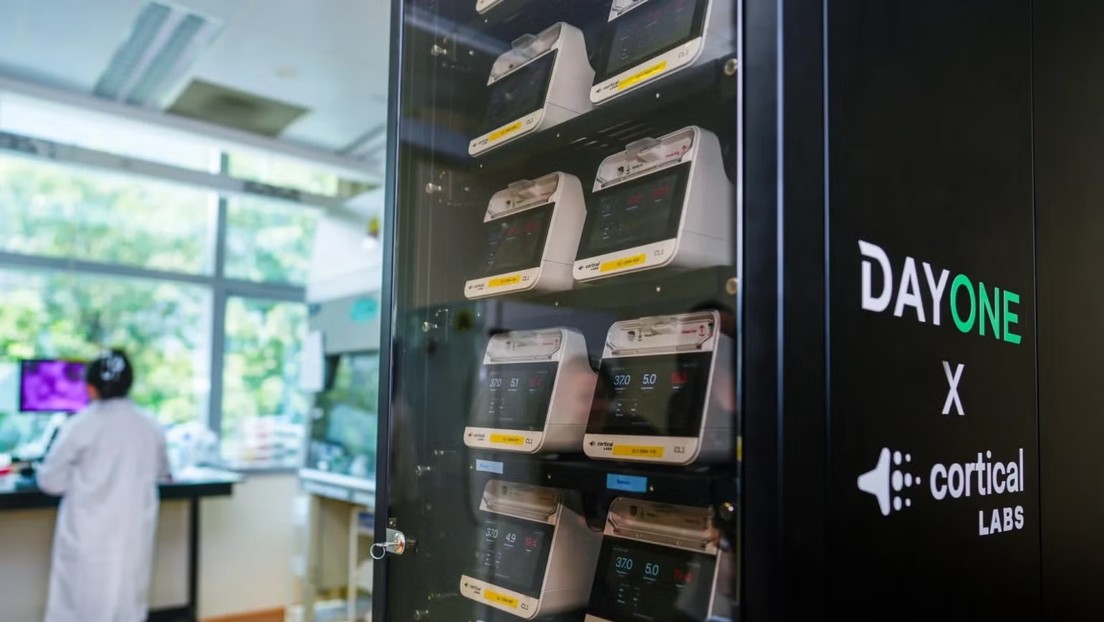
The Faculty of Medicine of the National University of Singapore, together with DayOne and Cortical Labs, launched a prototype data center that does not process with silicon but with living human neurons cultured from stem cells: 20 CL1 units, around 800,000 cells, and a total power consumption of between 800 and 1,000 watts.
What has just been turned on in Singapore
The National University of Singapore's Faculty of Medicine (NUS Medicine), digital infrastructure operator DayOne, and Australia's Cortical Labs presented a prototype data center that does not run on silicon processors, but on living human neurons. Its creators call it "wetware"—wet software—: brain cells derived from induced pluripotent stem cells, cultured on microelectrode arrays that translate electrical signals in both directions between the tissue and the digital world.
The setup brings together 20 CL1 biological computing units, the world's first commercial machine capable of having code deployed directly onto neurons. Altogether, the rack houses around 800,000 active brain cells. It is the first deployment of its kind outside Australia and the embryo of what Singapore aims to turn into the continent's first large-scale biological data center.
The number that makes the news interesting: 25 watts
Each CL1 unit consumes around 25 watts. The entire rack ranges between 800 and 1,000 watts: less than a household hair dryer, comparable to three or four desktop PCs turned on. Let's put that into context: a single training server with eight high-end AI accelerators is around 10 kilowatts, and AI data centers today are sized in tens of megawatts, with announced projects already talking about gigawatts.
The entire human brain operates on about 20 watts and continues to outperform any model in few-shot learning, adaptation, and generalization. That is the industrial bet behind the project: if energy efficiency becomes the real ceiling for AI scaling—and everything indicates that it will—biology ceases to be a laboratory curiosity and becomes an infrastructure strategy.
| Sistema | Consumo aproximado | Nota |
|---|---|---|
| Unidad CL1 (Cortical Labs) | ≈ 25 W | Neuronas humanas sobre matriz de microelectrodos |
| Rack biológico NUS / DayOne | 800 – 1.000 W | 20 unidades CL1, ≈ 800.000 neuronas |
| Servidor de IA con 8 aceleradores | ≈ 10.000 W | Un solo nodo de entrenamiento convencional |
| Cerebro humano completo | ≈ 20 W | ≈ 86.000 millones de neuronas |
| Centro de datos de IA típico | 20 – 150 MW | Escala industrial de silicio |
From Playing Pong to Executing Code
The story does not begin in Singapore. It begins in Melbourne in 2021, when Cortical Labs connected around 800,000 human and mouse neurons to an electrode array and set them to play Pong. The experiment—dubbed DishBrain—demonstrated something far more significant than the video game itself: the cells learned to reduce surprise from their environment, moving the paddle toward the ball in a matter of minutes and without any backpropagation algorithm involved.
The CL1, launched commercially in March 2025 in Barcelona, industrializes that experiment. It is a box roughly the size of a lunchbox with its own life-support system: pumps, filtration, temperature control, and a nutrient solution that keeps the culture viable for up to six months. Running on top is biOS—Biological Intelligence Operating System—which simulates a virtual world, translates it into electrical stimuli, and returns the neurons' response to the programmer as if it were the output of a function.
Put in developer terms: it is the first time the runtime is alive, has an expiration date, and needs to eat.
What It Is Really Good For (and What It Is Not)
It is worth bringing the headline down to earth. None of these machines is going to train a language model or replace a graphics accelerator. Their advantage is not raw power, but plasticity: learning new tasks with very little data and negligible power consumption.
The uses with immediate potential are in research: screening neurological drugs on actual human tissue instead of animal models, studying epilepsy, Alzheimer's, or Parkinson's in a system that responds in real time, and neurotoxicity testing. The project's promoters also point to future applications in robotics, cybersecurity, and fraud and scam detection—the latter being a field where recognizing anomalous patterns from just a few examples is worth its weight in gold.
And then there is the part that no one has solved: ethics. A culture of 800,000 neurons feels nothing and understands nothing; the current scientific consensus is clear on this matter. But the question of where the line is drawn—eight million? eight hundred million?—still has no regulatory framework in any country. Singapore, which has already built its reputation by regulating fintech and biotechnology before anyone else, knows perfectly well what it is buying into by hosting Asia's first rack.
Why Singapore and not somewhere else
Singapore concentrates a huge portion of Southeast Asia's data center capacity on a 730-square-kilometer island with no rivers, no hydroelectric power, and with 95% of its electricity generated from imported natural gas. In 2019, it went as far as freezing the construction of new data centers precisely because of energy consumption; the moratorium was lifted under strict efficiency conditions.
In that context, a rack that computes using 900 watts is not a laboratory curiosity: it is exactly the type of technology that a state with a hard energy ceiling has incentives to fund before anyone else. The same logic that led Singapore to bet on high-temperature tropical cooling and on recycled NEWater.
A Perspective from the Gaming Industry
At KingNews.online, we follow this for a very specific reason, and it is not science fiction. Systems for detecting fraud, table collusion, and anomalous player behavior are, technically, pattern recognition problems with scarce and imbalanced data: the interesting fraud is always the one that is not yet in the dataset. This is precisely the scenario where a system that learns from few examples outperforms a model that requires millions.
When we developed Jack7.co, our progressive jackpot system for live casino tables, the criterion was the usual one: the technology that prevails is not the most spectacular, but the one that reduces the cost per deployed unit until installing it is no longer a board-level decision. A 900-watt biological rack is still far from that. But the direction of the vector is unmistakable.
My bet, and I stand by it: the first mass commercial application of computing with living neurons will not be artificial general intelligence. It will be pharmacology. And the rest will arrive later, as always, through the service entrance.
Enlaces
Get KingNews in your inbox
Tech and gaming digest, no noise. Unsubscribe anytime.
Want to send us a news story?
Tell us your story. Our editorial team reviews it and gets back to you.
Would you like to advertise with us?
Write to us and we'll send you ad options and audience data.
More stories
Robótica · Inteligencia artificial · Sistemas autónomos
La colmena blindada: robots terrestres que podrían comandar enjambres de drones
Agrotecnología · Inteligencia artificial · Ganadería
La granja autónoma toma forma: IA, drones y robots llegan al campo

Inteligencia artificial · Empresas · Opinión
BMW adelgaza su dirección con IA: ¿ha llegado la hora del gerente artificial supervisado?
Inteligencia física · Agricultura · Robótica industrial
Polybot enseña a un robot a cosechar tomates mirando cómo trabajan los humanos
Inteligencia física · Robótica · Aprendizaje autónomo
El robot de Skild AI que aprendió a jugar fútbol contra sí mismo durante 140 años simulados

Movilidad eléctrica · Arabia Saudita